
One of the most persistent misconceptions in product development is that design is optional. When budgets are tight or deadlines are aggressive, design is often viewed as a luxury that can be postponed until later. The reasoning seems perfectly logical. Build the product first, validate the idea, and improve the experience once the business starts generating revenue.
Unfortunately, products do not work that way.
The cost of design is inevitable. It can be prepaid or it can be postpaid.
A prepaid investment means involving experienced designers early, while ideas are still inexpensive to evaluate, challenge, and refine. It requires spending money before there is visible software to demonstrate progress. That investment often feels uncomfortable because the return isn't immediately visible.
A postpaid investment feels far more attractive. You skip the upfront design effort, move directly into development, launch sooner, and promise yourself that you'll improve the experience in future releases. On paper, it appears to save both time and money.
What actually happens is something very different.
The Invoice Never Disappears
The money you chose not to spend on design doesn't magically disappear from the project. It simply reappears later in forms that are significantly more expensive and considerably harder to predict.
Every product accumulates decisions. Those decisions become code. The code supports business rules. Those business rules influence workflows. Those workflows shape customer expectations. Customer expectations affect documentation, onboarding, training, support processes, analytics, and every future feature built on top of them. What initially looked like a simple decision gradually becomes embedded throughout the entire product ecosystem.
Changing that decision later isn't difficult because someone needs to redraw a few screens. It becomes expensive because every dependency created after that original decision must now change with it.
The Economics of Change
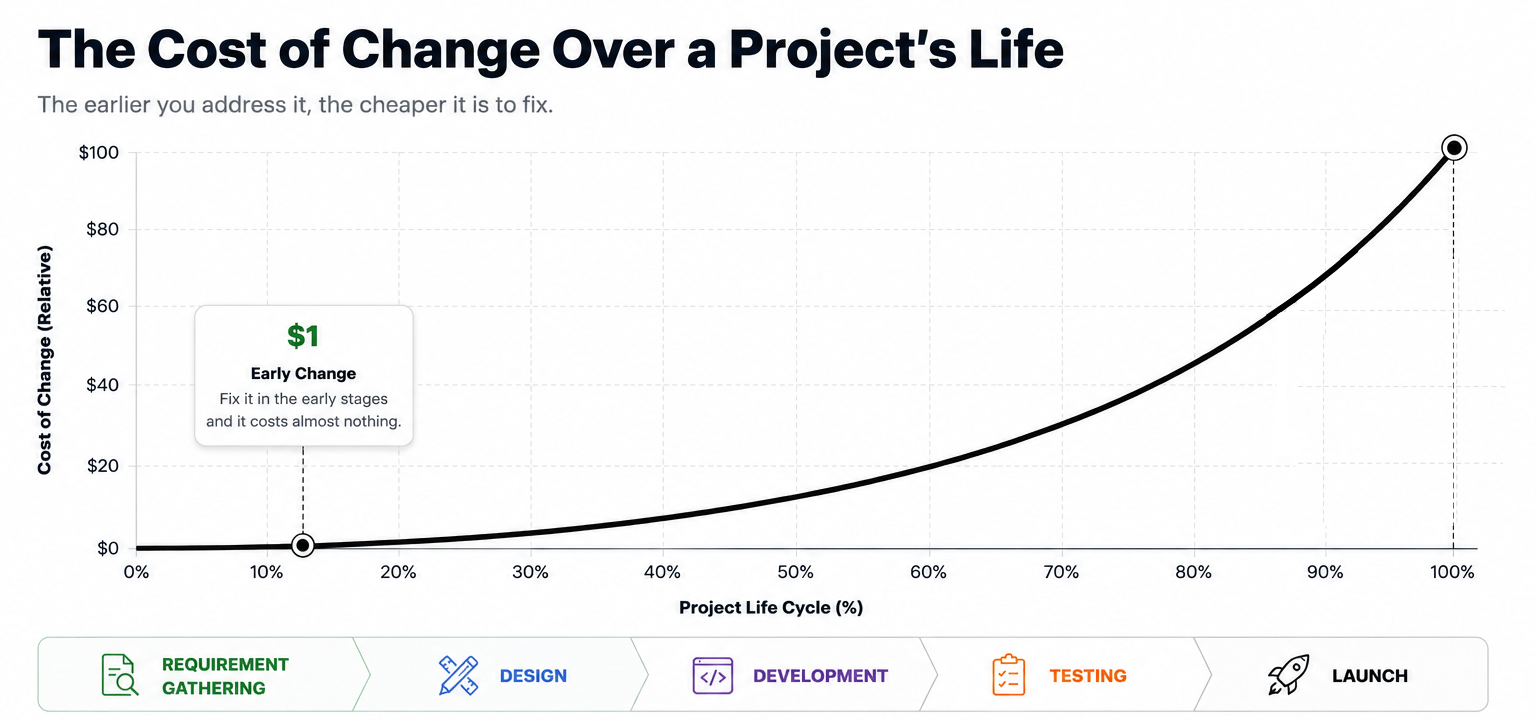
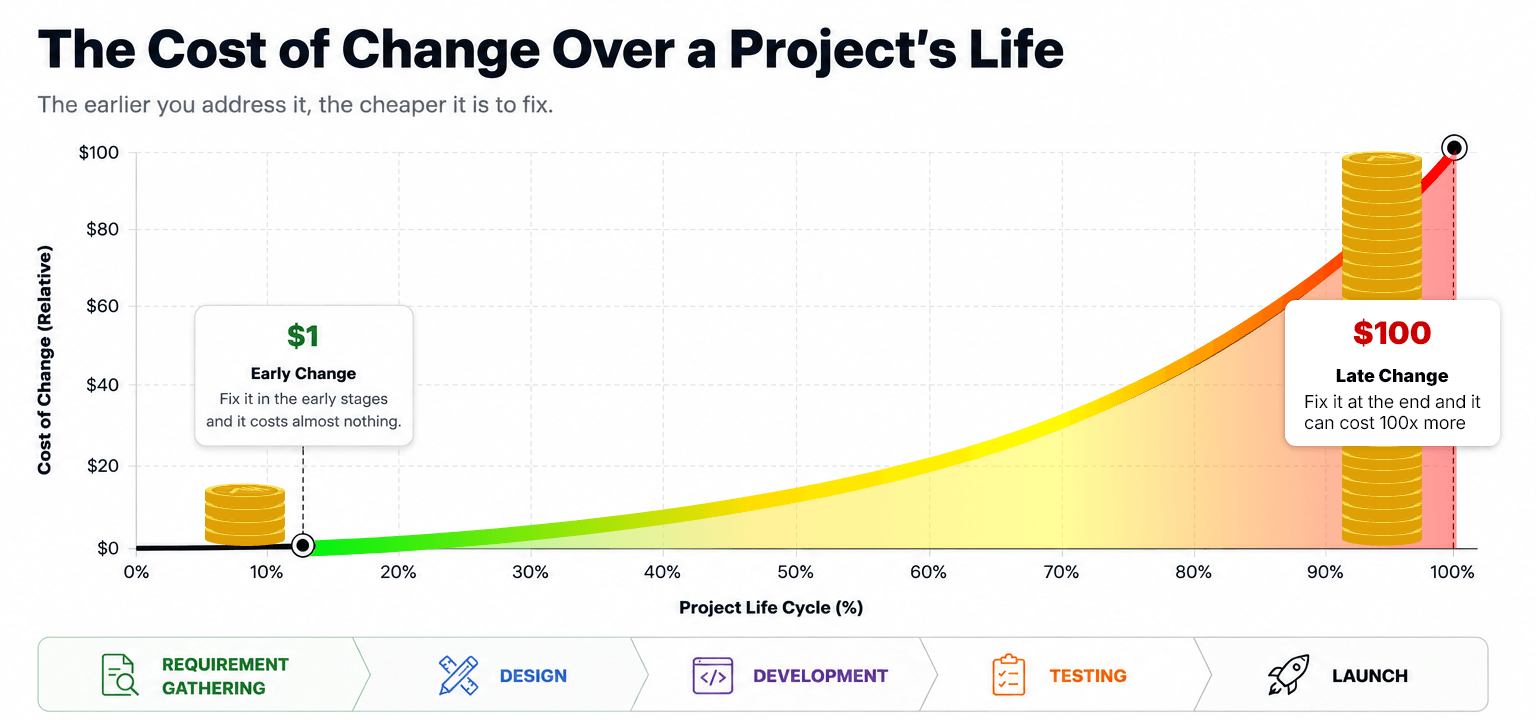
One of the most valuable concepts every product leader should understand is the cost of change. During the earliest stages of a project, changing direction is remarkably inexpensive. A workflow can be rethought during a meeting. A feature can be removed after a whiteboard discussion. An assumption can be challenged before a single line of production code exists.
As development progresses, every decision gains weight. Engineering effort has already been invested. Test cases have been written. APIs have been implemented. Integrations begin depending on previous assumptions. Documentation reflects the current behavior. Customers become accustomed to existing workflows. What once required a conversation now requires engineering, testing, deployment, communication, retraining, and careful coordination across multiple teams.
The decision itself hasn't become more complicated.
The consequences of changing it have become exponentially more expensive.
Why Organizations Keep Paying
When a product starts showing cracks, very few organizations simply abandon it. Founders have invested years of their lives. Investors have committed capital. Engineering teams have spent months building it. Sales teams have customers waiting. Product managers have roadmaps built around existing assumptions. Everyone involved has legitimate reasons to want the product to succeed.
So they continue investing.
They improve one workflow. They redesign another screen. They introduce a new feature to compensate for an earlier compromise. They simplify one process while inadvertently making another more complicated. Each improvement addresses a symptom, yet the underlying assumptions remain largely untouched because changing those assumptions would now be prohibitively expensive.
This isn't poor decision-making. It is often the only practical option available. Once enough time, money, and effort have been invested, organizations naturally try to recover that investment rather than start over.
The result is a product that slowly becomes more difficult to change with every release. Teams aren't merely building new capabilities anymore; they are navigating years of accumulated dependencies created by decisions that were inexpensive to question at the beginning but extremely costly to revisit later.
Design Is Really About Preserving Options
Many people think design is about creating interfaces.
Experienced product teams understand that design is actually about preserving flexibility.
The earlier important decisions are explored, challenged, and validated, the more freedom a business retains. Alternative workflows remain viable. Assumptions can be tested without expensive implementation. Customer needs can reshape the product before architecture, documentation, and organizational processes become dependent upon those decisions.
Good design doesn't eliminate future change. No product is ever finished, and no team gets every decision right the first time. The real value of design lies in making inevitable change affordable while the product is still flexible enough to accommodate it.
That is why mature organizations rarely view design as a cosmetic activity. They view it as an investment in reducing future business risk.
The Choice Is Only About Timing
Every successful product evolves. Markets change, customers change, competitors change, and businesses themselves change. Change is not the exception in product development; it is the rule.
The real question, therefore, is not whether you'll pay for design.
You will.
The only question is whether you'll invest while decisions are inexpensive and options remain open, or whether you'll pay later when every decision has become intertwined with engineering, operations, customer expectations, and years of accumulated complexity.
The cost of design is inevitable. Delaying it doesn't reduce the cost. It changes the timing, increases the price, and limits your options.