My answer is simple: yes, you need a UX designer.
Not because UX designers make products look beautiful. Not because every startup should blindly follow industry trends. You need a UX designer because every product has users, and every product therefore has a user experience. The only question is whether that experience is being designed intentionally or left to chance.
UX Is Not Screen Decoration
Many founders think UX starts when someone opens Figma and begins drawing screens.
That misunderstanding is expensive.
User experience begins long before screens exist. It starts with understanding the problem, identifying the users, defining their goals, understanding their constraints, and determining whether the proposed solution is worth building at all.
A good UX designer helps answer questions that most startups never think to ask:
- Who exactly is this product for?
- What problem are we solving?
- How are users solving this problem today?
- What would make them switch?
- What does success look like for the user?
- What should we avoid building?
Without those answers, development teams often become very efficient at building the wrong thing.
The Real Cost of Delaying UX
Founders often believe they can build first and improve the experience later.
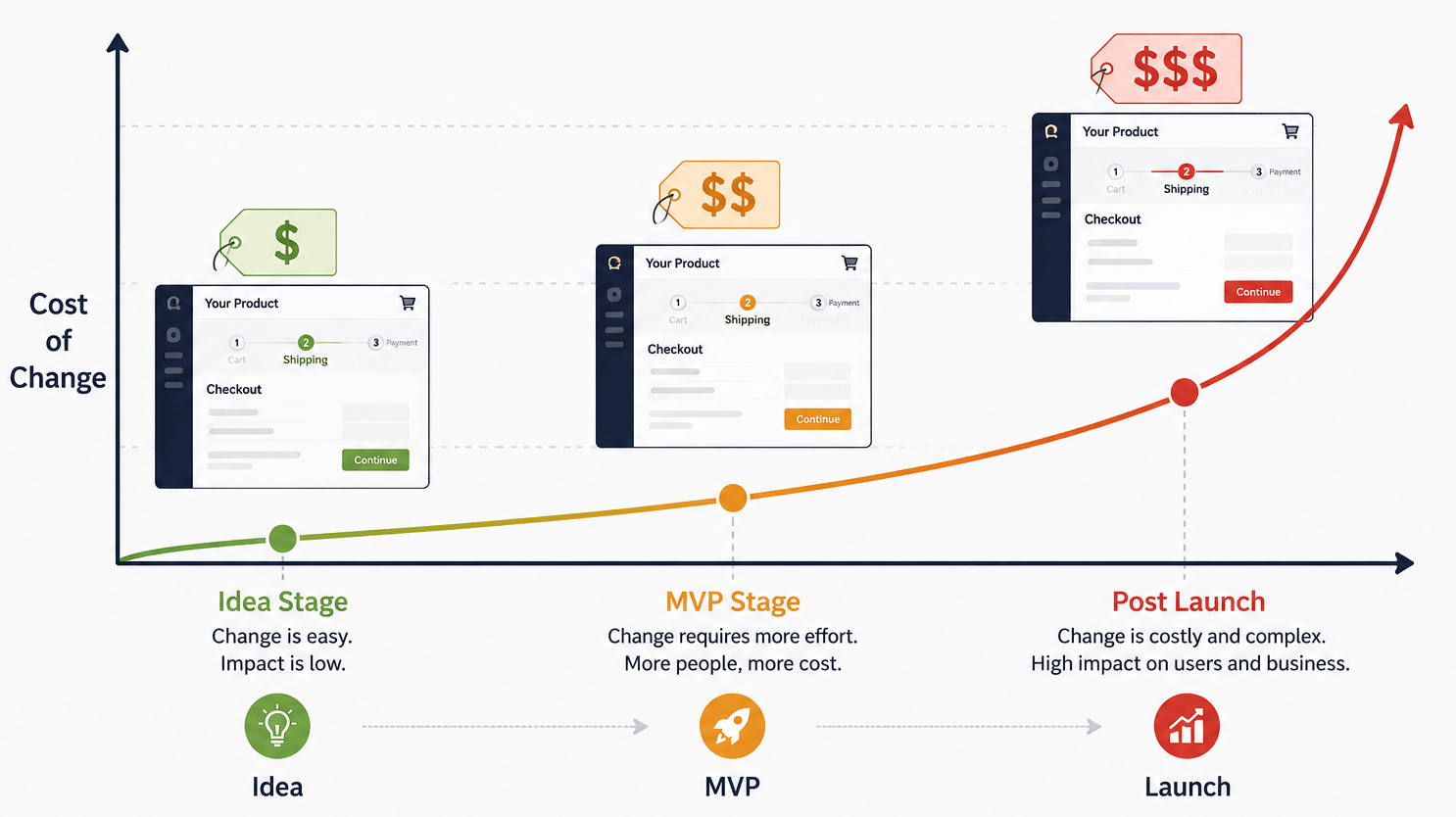
In reality, every delay increases the cost of change.
If a problem is discovered at the idea stage, fixing it may cost one dollar.
The same issue discovered during MVP development might cost five dollars.
After launch, the same correction may cost twenty-five dollars or more.
The numbers are illustrative, but the principle is universal: the later you discover a problem, the more expensive it becomes to solve.
This is why experienced product teams invest heavily in understanding users before significant development begins. They know that changing a sketch is cheap. Changing a live product is not.
UX and Product-Market Fit Are Connected
Many founders talk about product-market fit as if it exists independently from user experience.
It does not.
Imagine preparing for an important examination. You cannot study a single chapter and expect excellent results. You must understand the entire subject, identify knowledge gaps, and prepare comprehensively.
Launching a product works the same way.
You may have a brilliant idea. You may have exceptional technology. You may have a strong business model.
But if users cannot understand the value of your product, cannot figure out what to do next, or become confused while using it, none of those advantages matter.
A poorly represented idea is often judged as a poor idea.
Product-market fit requires users to understand, trust, adopt, and repeatedly use what you have built. User experience plays a role in every one of those outcomes.
How Do You Know You Need UX Leadership?
The signs are usually visible much earlier than founders realize.
From a user perspective:
- People seem confused during demonstrations.
- Users get lost while navigating the product.
- People ask questions that the interface should already answer.
- Users struggle to understand the value proposition.
From an internal perspective:
- Stakeholders disagree on priorities.
- Product and engineering teams interpret requirements differently.
- Front-end and back-end teams are not aligned.
- Features continue to expand without a clear rationale.
Many founders assume these are management problems.
Often they are user experience problems.
Good UX leadership creates alignment. It establishes a shared understanding of users, goals, priorities, and outcomes. The result is not just a better interface. The result is a more predictable product development process.
Most Startup Problems Are Not Technology Problems
Thousands of startups are built on solid technology.
Many still fail.
The reason is rarely that the code did not work.
Products fail because they solve the wrong problem, solve the right problem poorly, or fail to communicate value to users.
Technology can create capability.
User experience creates adoption.
Without adoption, technology alone rarely creates a successful business.
Can AI Replace a UX Designer?
This is the modern version of the question.
AI can generate wireframes, user flows, research summaries, design concepts, and prototypes faster than ever before.
That is impressive.
But speed is not the same as judgment.
Consider an analogy.
If someone with no knowledge of economics is asked to become an economic consultant, giving them access to AI does not suddenly make them an expert economist. AI can help them execute tasks, but it cannot replace the domain knowledge required to ask the right questions, evaluate trade-offs, and make sound decisions.
The same applies to UX.
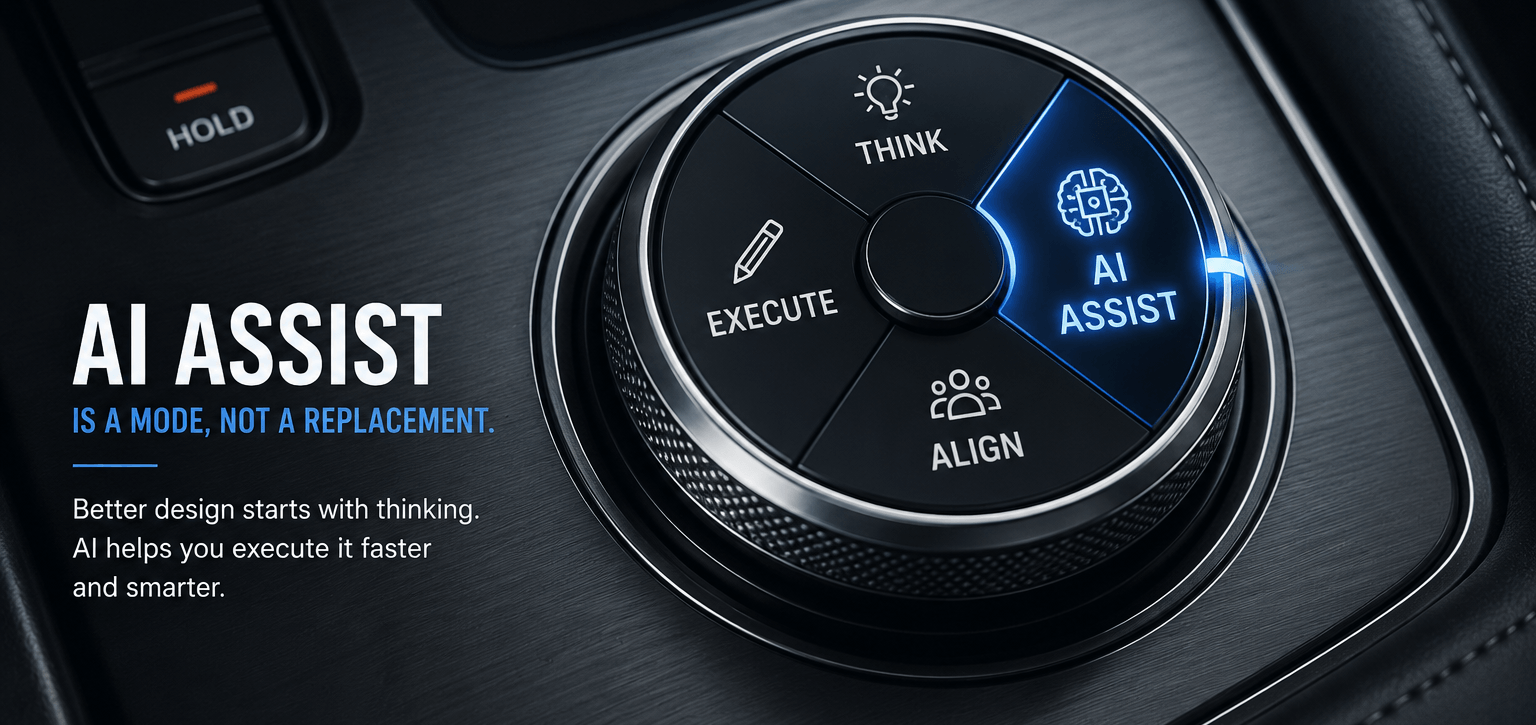
AI can amplify the capabilities of a skilled UX professional. It can accelerate research, generate alternatives, improve documentation, and reduce repetitive work.
What it cannot do is replace the experience required to understand people, facilitate stakeholder alignment, identify hidden assumptions, and make strategic product decisions.
The better the UX professional, the more valuable AI becomes.
AI is a force multiplier. It is not a substitute for expertise.
A Lesson From Experience
Years ago, I joined a large enterprise project that had already been running for more than two years.
After reviewing the work, I created a list of questions that I believed needed to be answered before the team could confidently move forward. The questions were not unusual. They focused on understanding requirements, user needs, and expected outcomes.
I suggested that we discuss them with the client.
The proposal was politely ignored.
Later, when the topic was raised again with senior leadership present, the response was revealing.
The concern was that if those questions were asked, the client might respond by asking what the team had been doing for the previous two and a half years.
In other words, the project had reached a point where exposing uncertainty felt riskier than addressing it.
The project continued for another six months before a major restructuring took place. Significant portions of the work had to be revisited, assumptions were challenged, and the project was effectively restarted.
Fortunately, the engagement survived.
But the rework could have been avoided if the right questions had been asked earlier.
That experience reinforced something I have seen repeatedly throughout my career: avoiding uncertainty does not eliminate risk. It usually increases it.
So, Do You Really Need a UX Designer?
If you are building a product that people will use, then yes.
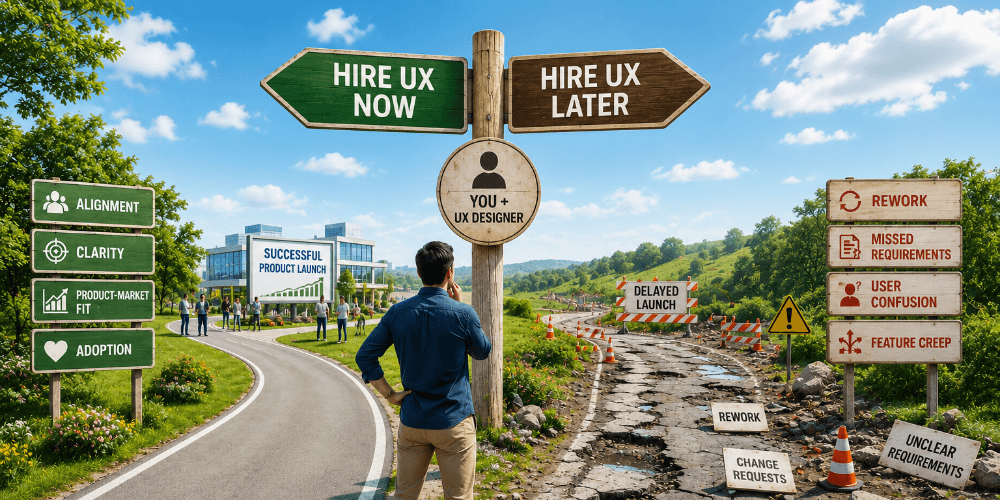
The better question is not whether you need UX. The better question is when you want UX involved.
My view is that UX should be present from the idea stage, or at the latest, the MVP stage.
That does not necessarily mean hiring a full-time designer immediately.
Today, founders have options. Fractional UX leadership, advisory engagements, workshops, and remote specialists can all provide access to experienced UX thinking without the cost of a full-time executive hire.
What matters is ensuring that user experience influences decisions before expensive assumptions become expensive mistakes.
Every successful product eventually discovers what its users need.
The smartest startups discover it before they build.