One question has followed me throughout my career:
"Why are we constantly redesigning screens?"
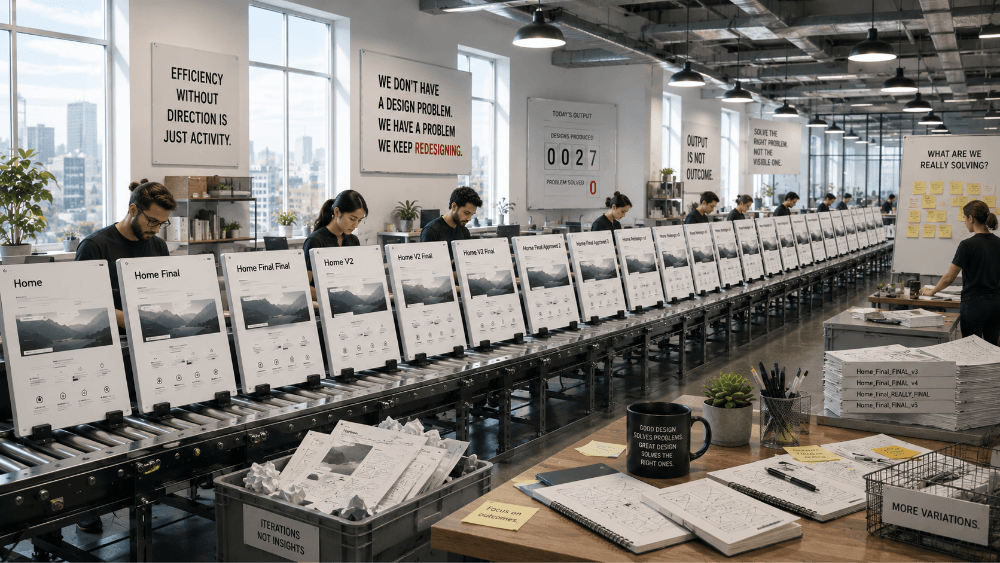
It is a familiar cycle. A product launches. Feedback arrives. Adoption is lower than expected. Support tickets increase. Stakeholders become concerned. The conversation quickly turns to redesigning the interface.
Notice how naturally that happens. Nobody says, "Let's revisit our assumptions about user behaviour." Nobody suggests reviewing the decision-making process that shaped the product. Very few ask whether the workflow reflects how people actually accomplish their work.
Instead, we redesign the screen.
There is nothing inherently wrong with redesigning an interface. Screens age. User expectations evolve. Business priorities change. Good products are continuously refined. The problem begins when redesign becomes the default answer before we have properly understood the question.
Searching Where the Light Is

Many years ago, I came across a simple cartoon that has stayed with me ever since. A child is searching for a lost coin under a streetlight. Another child joins the search. After several minutes of looking, the second child asks, "Are you sure you dropped it here?"
The answer is, "No. I dropped it over there. But the light is better here." While it has nothing to with design, yet it perfectly describes how many organisations solve problems.
We often search where the problem is easiest to see, not where it actually exists.
The interface is visible. Everyone can see it. Everyone has opinions about it. It is easy to discuss colours, layouts, buttons and navigation because they are tangible.
The underlying causes are much harder to examine. Product strategy. User understanding. Stakeholder alignment. Decision-making. Incentives. Process. These are less visible, less comfortable to discuss and considerably more difficult to change. Redesigning a screen creates a reassuring sense of progress. Whether it addresses the real problem is another question entirely.
What Stakeholders Really Mean
One mistake designers often make is assuming that executives misunderstand design because they ask for redesigns. I don't believe that is true.
Imagine a senior business leader reviewing a product that is underperforming. They know customers are struggling. They know business goals are not being achieved. They look at the interface and say:
"We need to redesign this."
That statement should not be interpreted literally. They are rarely saying, "Please move this button twenty pixels to the left."
They are saying, "This experience isn't delivering the outcome we expected." The word redesign is simply the vocabulary available to express dissatisfaction with the product experience.
A mature UX practice recognises the distinction. Its responsibility is not to translate stakeholder requests into screens. Its responsibility is to translate stakeholder requests into problems worth solving.
Lessons from Earlier in My Career
When I began my career, many design projects started with remarkably simple briefs.
"Design a homepage."
"Create a website."
That was often the entire problem statement.
There were no discussions about who the users were. Little understanding of business objectives. No conversation about what success would look like. User research was uncommon. Requirements were usually based on assumptions. We designed attractive interfaces and hoped they solved the right problems.
Sometimes they did. Most often, they didn't.
I still remember one particular project where we kept redesigning the homepage over and over again. Every review produced another version. Every version promised to be the one that finally solved the problem.
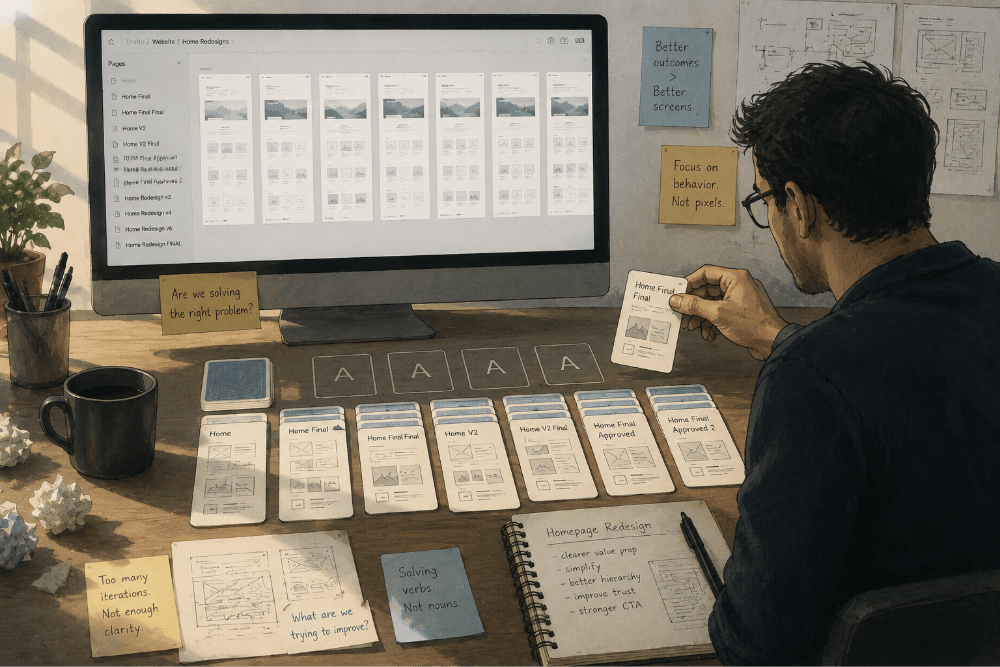
One night, after weeks of doing this, I had a dream that I was playing Solitaire with all the homepage designs we had created for that project. Instead of playing with cards, I was moving different homepage layouts around the screen, trying to make them fit together.
Looking back, the dream was almost absurd, but it captured exactly where my mind was. We had become so focused on rearranging screens that redesign itself had become the work. Whether we were solving the right problem had quietly disappeared from the conversation.
That experience stayed with me because it taught me something I would only fully understand years later: repeatedly changing the interface is not evidence that we are making progress. Sometimes it simply means we are getting better at changing the interface.
Solve Verbs, Not Nouns
One principle has profoundly influenced how I approach design. I cannot claim ownership of it, but I have adopted it because it consistently improves conversations.
Solve verbs, not nouns.
Whenever someone presents a problem statement, I ask a simple question.
Is the problem described as a noun or a verb?
If someone says:
- We need a chatbot.
- We need a dashboard.
- We need a communication platform.
- We need to redesign this screen.
None of these are actually problems.
They are proposed solutions.
Each one is a noun.
Now keep asking why.
Eventually the conversation changes.
- Teams need to coordinate work more effectively.
- Managers need to detect operational issues earlier.
- Customers need to complete purchases with less confusion.
- Employees need to find information without asking colleagues.
These are verbs. They describe behaviour. They describe outcomes.
Most importantly, they leave room for multiple possible solutions.
Perhaps the answer is a redesigned screen.
Perhaps it is a simpler workflow.
Perhaps it is clearer content.
Perhaps it is organisational alignment.
Perhaps it has nothing to do with the interface at all.
The moment we stop defining the solution and start defining the behaviour we want to improve, better design decisions become possible.
The Question Worth Asking
The next time someone suggests redesigning a screen, resist the temptation to begin sketching immediately.
Instead, ask one more question.
What are we actually trying to improve?
If the answer is still a screen, a dashboard, a chatbot or a homepage, the problem has probably not been defined yet. Keep digging until the answer becomes a verb. Because businesses rarely succeed by creating better nouns. They succeed by enabling better actions, better decisions and better outcomes.
A redesigned screen may still be the right answer. It just shouldn't be the first assumption.