Imagine a client asks you to make something absolutely unique.
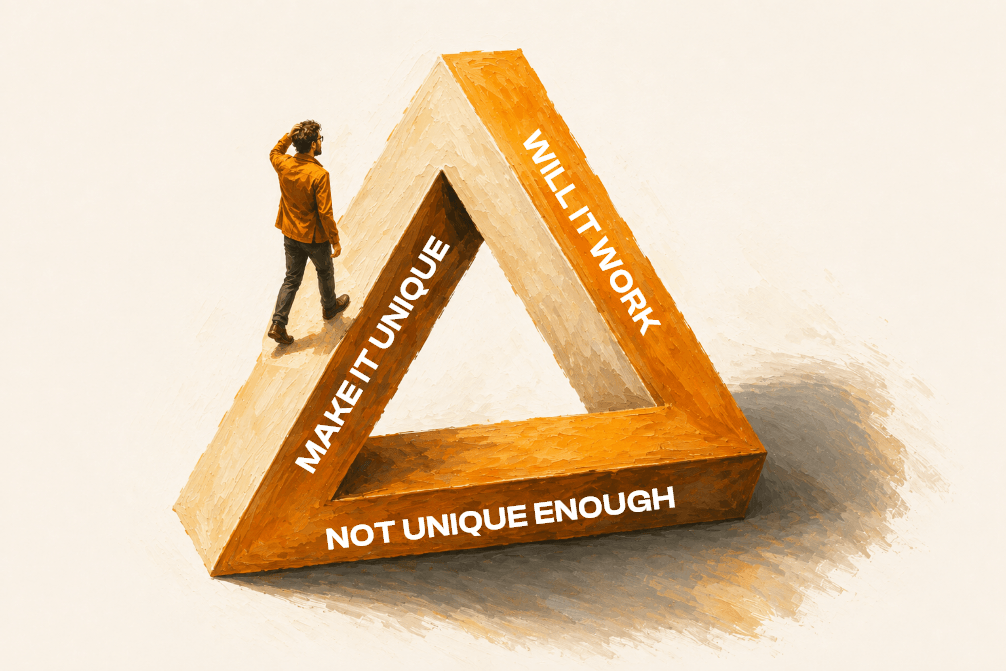
You accept the brief. You create something genuinely unfamiliar. The client looks at it and asks a reasonable question: “What evidence do we have that this will work?”
So you add familiar patterns. You introduce established conventions. You bring in research, precedent and guidelines. You make the solution easier to defend.
And now the client says: “But this isn't unique enough.”
So you go back to the drawing board.
This is the design version of the loop in Doctor Strange. You are Dormammu, the client is Doctor Strange, and every time you think you have solved the problem, you find yourself back in the same room.
“Make it unique” can be a brief that contains the mechanism for its own failure.
The contradiction is real
The problem is not that the client is unreasonable.
They may genuinely want something distinctive. They may be entering a crowded market, launching something important or trying to create an experience that people remember.
But there is another perfectly reasonable demand sitting underneath that one: “How do I know this is going to work?”
Those two demands pull in opposite directions.
The more familiar a design is, the easier it is to explain and defend. There are patterns that have been used repeatedly. There are design guidelines. There are conventions that users already understand. There are established ways of doing things that give everyone some confidence.
The more you move away from those things, the less evidence you have.
That doesn't make innovation impossible. It simply makes it harder to reassure the people who have to live with the consequences of the decision.
So the designer is asked to produce something that is both unfamiliar and reassuring.
That is where the loop begins.
Sometimes “unique” isn't really about uniqueness
Experience has taught me to be suspicious of design requests that sound purely aesthetic or functional.
There is often another problem underneath them.
A stakeholder may be worried about being perceived wrongly by users. They may be worried that their boss will blame them if the project fails. They may need to demonstrate that they contributed something meaningful. They may simply be uncomfortable making a decision that nobody can point to as having been done before.
In those situations, “make it unique” can become a proxy for a much more complicated request.
It can mean: “Give me something that makes this project feel important.”
It can mean: “Give me something I can defend.”
It can even mean: “Give me evidence that I am making the right decision.”
Those are not design problems in the conventional sense.
And if we treat them as design problems, we can spend an extraordinary amount of time changing screens while never addressing the thing that is actually making the decision difficult.
The younger designer wants to have the answer
One of the things that changes with experience is the belief that the designer is supposed to be the smartest person in the room.
When I was younger, I could hear a stakeholder asking for changes and assume that my job was to come up with a better design until they were satisfied.
It took experience to understand that sometimes the person asking for changes isn't really looking for a better design. They are trying to solve a problem of their own.
That distinction matters.
If someone needs to justify their presence, changing the design may temporarily give them something to point at. But it doesn't necessarily make the product better.
The mature response is not to become better at producing endless variations. It is to become better at understanding what is driving the request.
The request you hear is not always the problem you need to solve.
This is also why objectivity is so valuable in design. When a decision can be grounded in evidence, established principles or observed user behaviour, the conversation becomes less dependent on who has the strongest opinion in the room.
But there is a limit to what objectivity can accomplish.
What happens when nobody wants the answer?
Sometimes the problem is not that there is insufficient evidence. The problem is that the evidence would make somebody uncomfortable.
A design decision can affect someone's authority, reputation or sense of control. In those situations, giving people a better rationale may not resolve the conflict.
You can explain why the architecture should change.
You can explain why the content needs to change.
You can explain why the information should be sequenced differently.
And still be told that none of those things can change.
Eventually, you can find yourself doing something that looks like design but isn't really design anymore: applying visual style to decisions that have already been made.
That is a dangerous point in an engagement because the designer can still believe the project is salvageable.
One more iteration.
One more workshop.
One more revision.
One more attempt to make everybody comfortable.
And this is where another psychological trap appears.
The cost of staying
Designers and agencies are not immune to the sunk-cost fallacy.
In fact, the structure of client work can make it particularly seductive.
You have already invested time. Other people have invested time. Travel may have been arranged. Relationships have been built. Someone may have recommended you. Your team may already have spent weeks on the engagement.
Walking away makes all of that feel wasted.
Continuing feels like giving yourself one more chance to recover the investment.
That is exactly what makes the trap so powerful.
The money, time and effort already spent are gone. They should have no bearing on whether the next hour is worth spending. But emotionally, they do.
The question is not whether the project could still be rescued. Almost anything can be rescued in theory.
The better question is whether the conditions exist for the next investment of time to produce something worthwhile.
Don't decide whether to continue because of what you have already invested. Decide based on whether the next investment still has a reasonable chance of creating value.
There is a point where leaving is the design decision
Walking away from an engagement is difficult because it can feel like failure.
But there is a difference between abandoning a difficult problem and recognising that you no longer have the agency required to solve it.
If every meaningful design decision is blocked, if evidence is unwelcome, if the scope of your influence has been reduced to execution and if the remaining work is unlikely to change the outcome, continuing may not demonstrate commitment.
It may simply increase the eventual loss.
For designers and agency leaders, this is one of the harder judgements to develop because it requires saying no not only to the client, but sometimes to your own previous investment.
You have to be willing to say: we cannot produce the work we were engaged to produce under these conditions.
Sometimes that conversation changes the engagement. The other side has invested too much to let you walk away and is willing to change how the work gets done.
Sometimes it doesn't.
Either way, you have replaced an endless cycle of accommodation with an explicit decision about the conditions required for success.
So what should you do when someone says “make it unique”?
Don't reject the request.
Don't immediately accept it either.
Ask what uniqueness is supposed to accomplish.
Different from what?
For whom?
Why does being different matter?
What are we afraid will happen if we are not different?
What decision is the stakeholder actually trying to make?
And what would make them confident enough to make it?
The answers may lead to an innovative design. They may lead to something surprisingly conventional. They may reveal that the real requirement has nothing to do with visual or interaction design at all.
That is not a failure of the brief.
It is the beginning of understanding it.
The most important thing is to recognise the loop before you become trapped inside it.
Novelty creates uncertainty. Uncertainty creates a demand for reassurance. Reassurance often pushes the work back toward familiar territory. Familiarity then triggers another demand for novelty.
And around you go.
The answer is not to become infinitely better at satisfying both sides of the contradiction.
The answer is to understand why the contradiction exists.
Sometimes that means changing the brief.
Sometimes it means changing the way decisions are made.
And sometimes, when there is no longer enough agency to do meaningful work, it means walking away.
Not every design problem should be solved.
Some should be understood.
Some should be renegotiated.
And some should be left behind before they consume more of the people trying to solve them.