The question
Under the joke is a plainer question: who do you think you are?
A manifesto sounds like a declaration of importance. It suggests the author believes the rest of us should pay attention to how they think. If I had met my own on someone else's website, I'd have been just as sceptical.
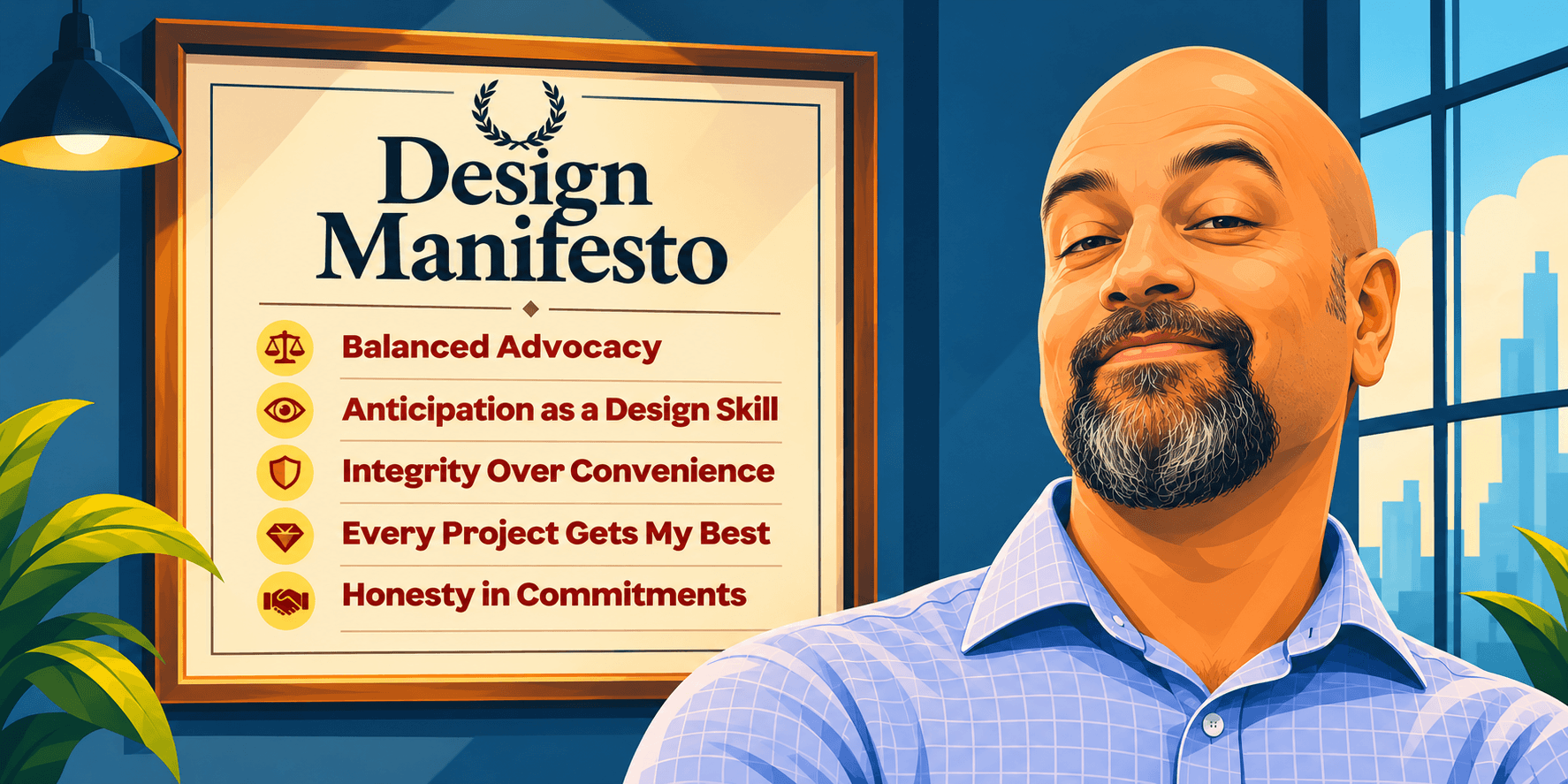
So before you read any of the nine principles, I owe you an honest answer.
I don't think I'm important. What I have is a lot of years in this field and a growing awareness that those years are finite. I will stop being relevant eventually. The work will change, the tools will change, and the problems I understand best will either take new shapes or disappear. Before that happens, I'd like to say what I've learned, in a form that someone can read, disagree with, or hold me to.
I should also admit that part of me wants to be read. Anyone who writes in public and claims otherwise isn't being straight with you. My blog doesn't get many visitors, and sometimes that stings. I don't check the numbers often, and I keep writing anyway. That tells me the writing is not mainly for the audience. It's for the saying.
The manifesto I didn't publish
This isn't the first manifesto I wrote. The first was about corporate life: what a job is, and what a company owes the people who work for it. I took apart lines like "we're a family," because a family doesn't let a member go when the numbers look bad. I worked on it for a while, and then I dropped it. Plenty of people were already saying those things, and I wanted something more personal.
So I narrowed. I wrote about the one subject where I've put in more than twenty-five years: design. It was smaller, and it was mine.
You haven't broken my will
There is one more reason I wrote this, and it isn't humble.
Over a long career, my team and I made many decisions I didn't agree with. Each had a reason, and the reasons varied. Often I went along to avoid a fight.
This isn't a verdict on anyone. I'm not sitting in judgment of the people in those rooms. But you may have made me do something. You didn't break my will. I still believe what I believe.
One of many times I broke my own rules
The manifesto describes a person I haven't always been. I have broken my own rules many times. Here is one of them.
I was brought in to redesign a government website. I made a plan and built a strategy. Then the constraint arrived: no changes to the content, no changes to the structure. The only thing left to change was how it looked. It was a reskin.
I believe design has to be judged against parameters everyone has agreed on in advance, never against someone's taste. A reskin has no such parameters. Its success is a matter of opinion. I went against my own judgment and said yes anyway, and the project was a disaster.
My reasons had nothing to do with design. We were two layers removed from the client: the government hired one agency, that agency hired a second, and the second hired my partner, a friend who runs a small IT company and brings me his design work. I had already flown to the client's city once. By the time the constraint surfaced, I had spent the money and the time, and I could see what walking away would mean for him. He would have to explain to the agency above him why we were pulling out, and a small business lives on those relationships. I didn't want to put him there. I also didn't want to lose the project.
There was a last reason, and it's the least defensible. I know how projects like this end: in disaster and in strained relationships. And still, sometimes, I tell myself this one will be different. It's the logic of someone who has been shocked by a socket and puts a finger back in, sure that this time it won't happen. It never is different.
A sunk cost, a favour to a friend, a fear of losing work, and plain stupid optimism. None of them was a design reason, and none of them was a design decision. But they were decisions, and a designer made them.
Why now
For the past few years I have been practising these principles, and I wrote them down only now. Saying what you believe plainly is a risk. People can check you against it, and they can decide you're wrong. I'm ready for both. I am past the stage where I'm trying to be liked by the right people.
Not a gate
Life is not black and white. It is gray, and a choice sometimes arrives disguised as something else. I make it, and only later do I see that it went against one of the nine principles.
Every law in economics holds if all else stays the same. All else never stays the same. My principles are no different: things happen that contradict them, and I don't always see it coming.
That isn't a loophole. These nine principles are my commitment to every client, what I will do, and I work with them on purpose, because they are what make it possible for me to do good work. The commitment is real, and so is the gray.
This isn't a gate. No request gets stopped at the door for failing a checklist, because life is more fluid than that. What I can do is hold myself to the standard I've written down, and keep trying.
That's what this manifesto is. It isn't a record of how good I am. It's a standard I'm choosing to hold in public, so you can see when I fall short of it.