If you've spent enough years leading design teams, you'll eventually realise that many escalations aren't caused by bad design. They're caused by conversations that go wrong long before the design itself becomes the issue. I learnt this the hard way.
Every few weeks, I would find myself stepping into a meeting that I should never have been invited to. A client or an internal stakeholder had complained that a designer had been argumentative, dismissive, or difficult to work with. My role was no longer to lead design. It was to mediate a conversation that had already broken down.
What made these situations frustrating was that my team wasn't being disrespectful, they genuinely believed they were doing the right thing. They were trying to protect the product, defend good design, and prevent poor decisions. Their intentions were good. Their communication wasn't.
Most escalations are not created by disagreement. They are created by how disagreement is expressed.
After seeing the same pattern repeatedly, I decided not to conduct another communication workshop or create another document full of best practices.
Instead, I gave my team one surprisingly simple rule.
For a While, Don't Use Two Words
I asked the team to avoid using two words during stakeholder conversations:
- No
- Why
The rule wasn't literal, it wasn't a permanent ban. It wasn't about agreeing with every stakeholder. It certainly wasn't about avoiding difficult conversations.
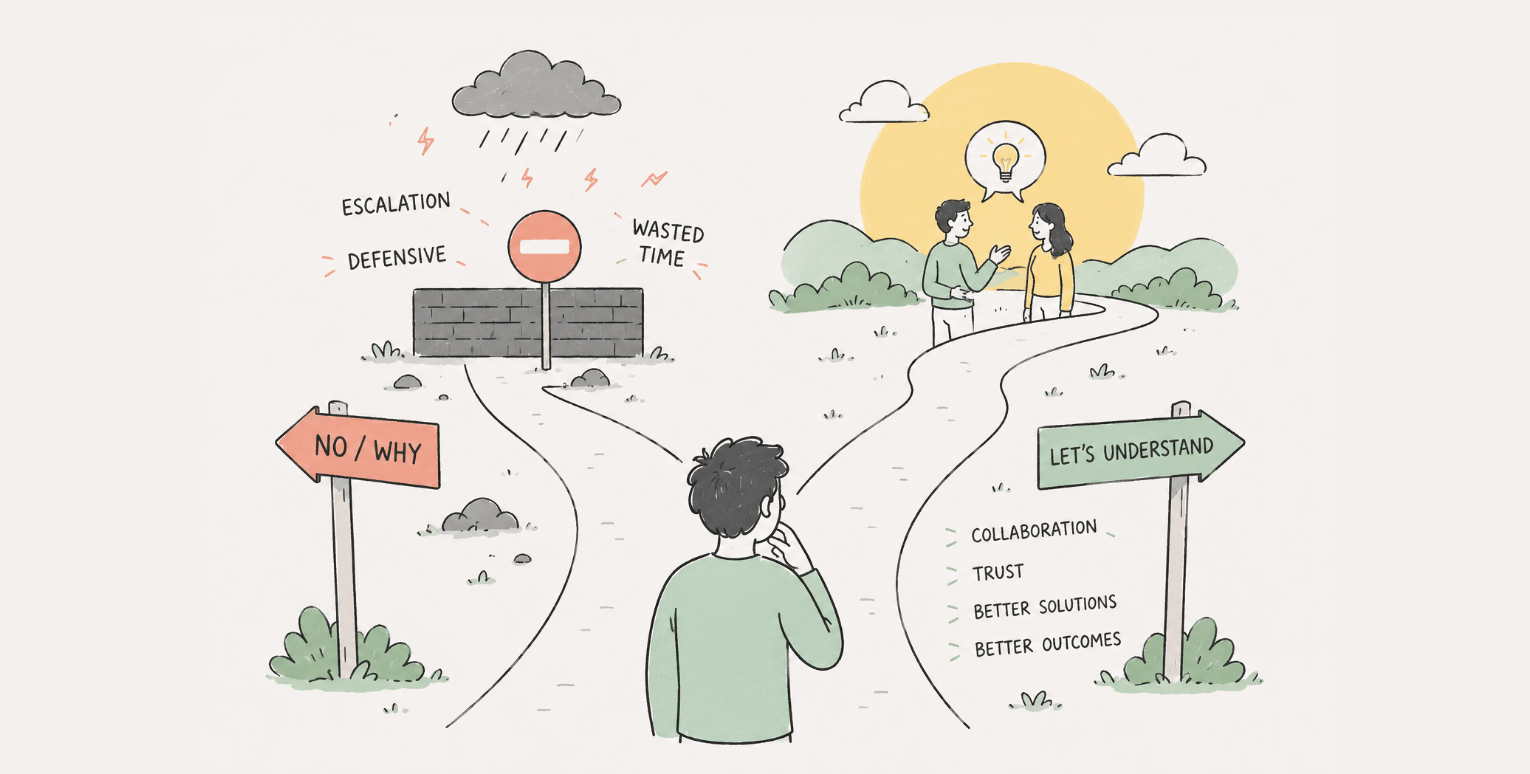
It was a coaching constraint. I wanted to interrupt an instinctive communication pattern and replace it with a more thoughtful one. Because the moment someone says:
"No."
the conversation often stops being about solving a problem. It becomes about defending positions.
Likewise, when someone immediately responds with:
"Why?"
the other person can easily hear:
"Justify yourself."
That wasn't what my designers intended. But intention doesn't determine how communication is received.
Changing the Conversation
Instead of saying:
"No, we shouldn't do that."
I encouraged them to respond with something closer to:
"That's certainly one way of approaching it. My concern is that it could introduce a few challenges. Let me explain what those might be, and perhaps we can explore another approach that achieves the same objective."
Notice what changed. The disagreement didn't disappear. The design opinion didn't change. The risks were still discussed. Only the structure of the conversation changed.
Similarly, instead of asking:
"Why do you want to do that?"
I encouraged responses like:
"Help me understand the outcome you're trying to achieve so we can find the best way of getting there."
Again, the designer is still gathering information. The only difference is that the question invites collaboration instead of sounding like a challenge.
The Unexpected Result
Something interesting happened once the team adopted this approach. The number of escalations began to reduce. Meetings became more productive. Stakeholders became less defensive.
More importantly, many disagreements were resolved during the meeting itself instead of travelling up the management hierarchy. That had consequences far beyond communication.
Every escalation avoided meant:
- faster decisions,
- less management intervention,
- greater stakeholder confidence,
- stronger working relationships, and
- more time spent solving product problems instead of repairing conversations.
The quality of the design discussions improved because both sides were trying to solve the same problem instead of trying to prove who was right.
Good stakeholder conversations are not about winning arguments. They are about helping everyone arrive at a better decision together.
This Was Never About Two Words
Let me be clear, I'm not suggesting that the words "no" and "why" should disappear from your vocabulary. There are situations where both are entirely appropriate. The rule was designed for a specific team facing a recurring communication problem.
The point wasn't the words themselves. The point was that removing those easy, instinctive responses forced people to pause. Instead of reacting, they had to think. What concern am I trying to express? What risk am I trying to highlight? What outcome is the stakeholder actually trying to achieve?
Once those questions became part of their thinking, better conversations followed naturally.
A Simple Experiment
If you're leading a team—or if you regularly find yourself in difficult stakeholder conversations—try this for one week.
Every time you're about to say "no", explain the consequence instead.
Every time you're about to ask "why", ask about the objective you're trying to understand.
You may still disagree. You may still challenge assumptions. You may even arrive at exactly the same decision. But you'll probably discover that the conversation feels very different. And sometimes, that's all it takes to prevent a disagreement from becoming an escalation.