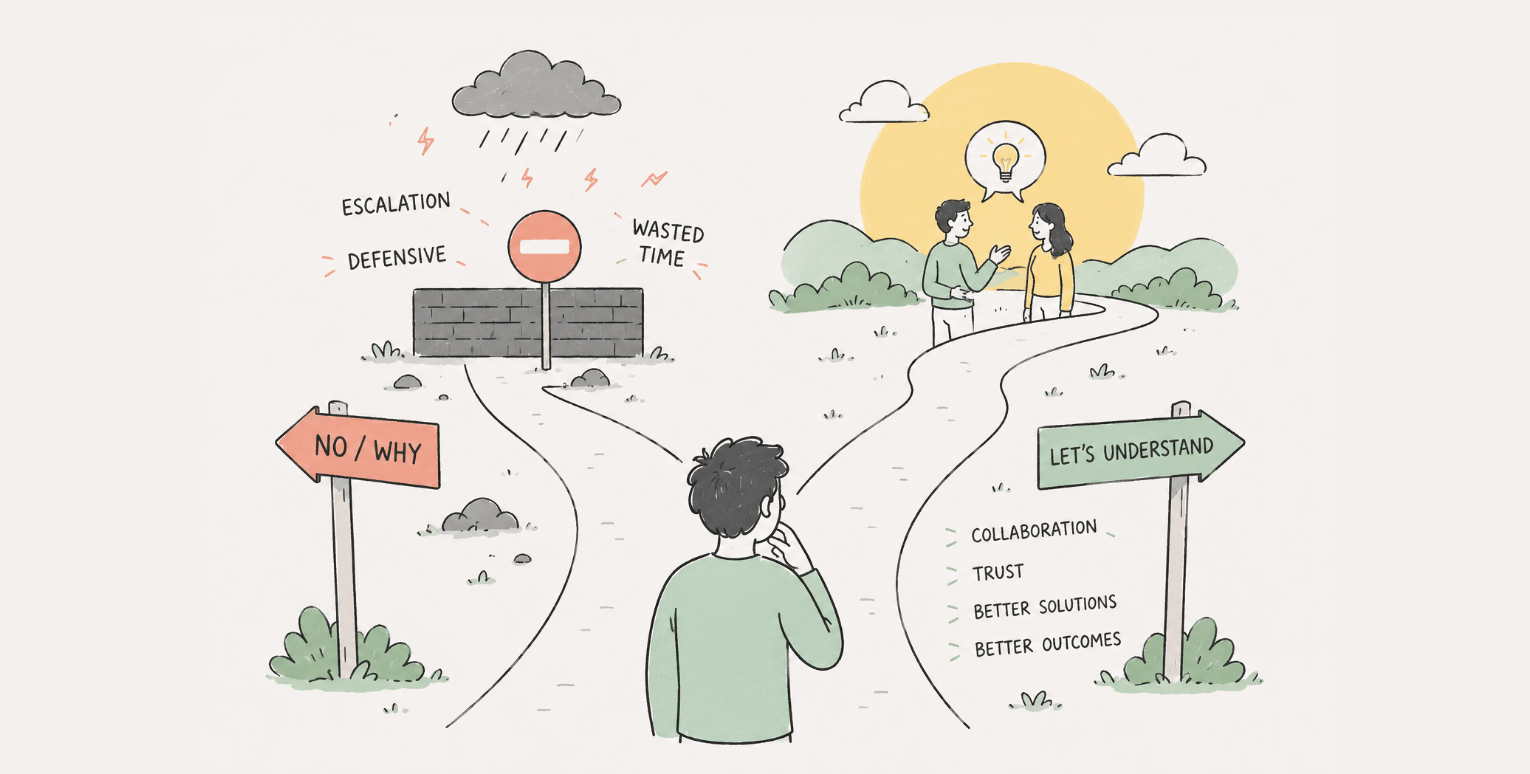
Recently, I received a message from a designer just out of college asking for guidance on how to pursue a career in UX Design. She had completed multiple internships but still not able to get a job as most employers either ask for experienced designers. The question was "What should I do to get into a good product company?"
I could immediately relate to the frustration behind that question. Imagine spending three or four years studying design, completing assignments, building a portfolio and investing months in internships, only to discover that companies still hesitate to hire you. It is easy to conclude that the market is unfair or that your portfolio simply isn't good enough.
Sometimes that may be true, but after spending many years interviewing designers, I believe there are other reasons that aren't discussed often enough.
Many graduates prepare for the interview they think they are attending. Experienced hiring managers are evaluating something completely different.
The Question Behind Every Interview
Candidates believe an interview is trying to answer questions like these:
- Can this person create beautiful screens?
- Do they know UX terminology?
- Can they use Figma well?
- Have they completed enough internships?
Those things certainly matter, but they are rarely the deciding factor. The real question hiring managers are trying to answer is much simpler.
"Can I trust this person to solve the problems my product team is facing?"
That's a very different question. Companies are not hiring designers because they need more screens. They are hiring someone dependable to whom the can outsource their design problems.
Those problems may involve improving conversions, reducing customer support calls, simplifying a complex workflow, increasing engagement, improving accessibility, or making a product easier to learn.
The interface is only one part of the solution. Once you begin looking at interviews from that perspective, many hiring decisions suddenly make much more sense.
What Changed My Own Thinking
Early in my own career, I approached interview assignments the same way many young designers do today. I believed that my responsibility was to produce the best possible design. If the screen looked polished enough, surely the work would speak for itself. With experience I realised something important.
Later, with experience I realised that this not enogh. In one job interview, I wass asked to redesign a dashboard. The assignment wasn't really about just redesigning a screen, It was an opportunity to demonstrate how I think. So instead of sending only the redesigned screens, I documented every important decision I had made. I explained why I combined certain sections. I explained why I separated others. I documented the assumptions I had made.
I even explained what I deliberately chose not to improve because it wasn't part of the problem I had been asked to solve.
Looking back, I don't think the redesigned dashboard got me the job. I think my thinking did.
What I Learned from Sitting on the Other Side of the Table
Over the years, I also found myself on the other side of the interview table, evaluating designers for product teams.
One observation kept repeating itself, the strongest portfolios weren't always attached to the strongest designers.
Likewise, candidates who could confidently discuss personas, empathy maps, user journeys and every UX framework weren't always the people who demonstrated the strongest problem-solving ability.
Don't misunderstand me.
Those frameworks are valuable. They provide structure, create a common language and help teams solve problems consistently.
The mistake is treating them as a checklist instead of a thinking tool.
Design frameworks exist to help you reach better decisions. They are not a compliance exercise.
The candidates who consistently impressed me did something different.
They listened carefully before answering. They asked thoughtful questions. They recognised assumptions. They explained their trade-offs.
Most importantly, they demonstrated how they thought instead of expecting me to infer it from a polished screen. If you remember only one thing from this article, let it be this:
A portfolio shows your work. A conversation should reveal your thinking.
So What Should You Do Differently?
Understanding the problem is useful.
But understanding alone won't help you get hired.
Let's now talk about what you can actually do over the next six to twelve months to become the kind of candidate good product companies actively want to hire.
1. Build One Meaningful Passion Project
If I could give only one piece of advice to a student, this would be it.
Don't spend your time creating ten disconnected portfolio projects. Build one meaningful project that you genuinely care about and keep improving it over many months.
My own passion project happened to be a blog. Yours could be a mobile app, a SaaS product, a design system, an AI assistant, a budgeting app, a fitness tracker or anything else that genuinely interests you.
The project itself is not important. Your commitment to improving it is. Every time you return to your project, you'll discover something that could be better. That improvement will expose a gap in your knowledge You'll start reading. You'll experiment. You'll make mistakes. You'll troubleshoot.
You'll discover new tools, technologies and techniques because your project demands them—not because someone added them to a syllabus.
That's how genuine learning happens. Over time, you'll know more than someone who only completed classroom assignments because you'll have solved real problems instead of hypothetical ones. Every improvement you make to your passion project should teach you something you didn't know before. That doesn't just increase your knowledge, it increases your capability.
And people who can solve a wider range of problems become more valuable designers.
2. Don't Just Tell Companies You're Good. Show Them.
If you've already graduated and your interviews are around the corner, don't worry about what you should have done six months ago focus on what you can do today.
The best time to plant a tree was 20 years ago, the next best time is today.
Ask yourself a simple question.
"How can I demonstrate my thinking instead of merely claiming that I have it?"
One of the most effective ways to do this is to evaluate a product belonging to the company you're interviewing with.Don't redesign it just to make it look prettier. Study it. Identify opportunities for improvement. Explain what problems you found. Suggest how you would solve them.
More importantly, explain why you would solve them that way.
This demonstrates two things immediately. First, it shows initiative. Nobody asked you to analyse that product, you chose to. That tells me you're curious, resourceful. Second, it allows me to observe your thinking.Instead of asking me to trust your portfolio, you're allowing me to see how you approach a real problem.
That's a far stronger signal than simply saying, "I'm passionate about UX."It is the difference between telling and showing. A hiring manager can interpret a polished screen in many different ways. But when you explain your assumptions, your reasoning and your trade-offs, there is much less ambiguity.
You're helping them understand how your mind works. And that's exactly what they're trying to evaluate.
3. Learn to Explain Your Decisions
Design doesn't happen inside Figma, it happens in conversations.
Every meaningful design decision eventually needs to be explained to someone - a product manager, an engineer, a client, a stakeholder.
Or an interviewer.
If you simply show a screen and expect people to appreciate your thinking automatically, you're leaving too much to interpretation. Instead, learn to explain your work.
Why did you combine these sections?
Why did you remove this feature?
Why is this information more prominent?
What assumptions did you make?
What would you validate before shipping this solution?
Those answers often matter more than the screen itself. Remember, interviewers aren't trying to hire a portfolio. They're trying to hire someone they can trust with difficult decisions.
4. Understand the Business Problem, Not Just the Design Problem
One of the biggest differences between a student assignment and a real product is that products exist for a reason.
Every business is trying to solve a problem.
Sometimes that problem is acquiring more customers.
Sometimes it's increasing revenue.
Sometimes it's reducing support costs.
Sometimes it's improving customer satisfaction.
The interface is only one part of that solution.
The better you understand the business objective, the better your design decisions become.
This is also why experienced designers ask so many questions before they begin designing.
They're trying to understand the problem before proposing a solution.
As a fresher, developing this habit gives you an enormous advantage because it demonstrates maturity far beyond your years of experience.
5. Keep Learning From People Who've Already Solved These Problems
One habit that has stayed with me throughout my career is learning from experienced practitioners.
Technologies change. Design trends change. AI will continue to change how we work. But thoughtful practitioners continue to teach principles that remain relevant for decades.
Read books. Read thoughtful articles. Follow experienced practitioners whose work makes you think differently. The more perspectives you expose yourself to, the better equipped you'll be when you need to defend a design decision.
Good designers don't argue with opinions, they explain their reasoning using established principles, evidence and experience.
The Goal Isn't to Get a Job
That may sound like a strange statement in an article about getting hired.
But hear me out.
If your only objective is getting your first job, you'll naturally optimise for interviews. If your objective is becoming an exceptional designer, you'll optimise for learning. Ironically, the second approach usually leads to the first. Good companies aren't looking for people who have memorised UX terminology, they're looking for people who are curious enough to keep learning, disciplined enough to keep improving and thoughtful enough to solve problems that matter.
If you spend the next six to twelve months becoming that person, you'll not only improve your chances of getting hired, you'll also lay the foundation for a much stronger career.
Don't spend the next year trying to become someone who creates better screens. Spend it becoming someone who understands problems better, learns continuously and can clearly explain the reasoning behind every design decision.
That's the kind of designer good companies remember.