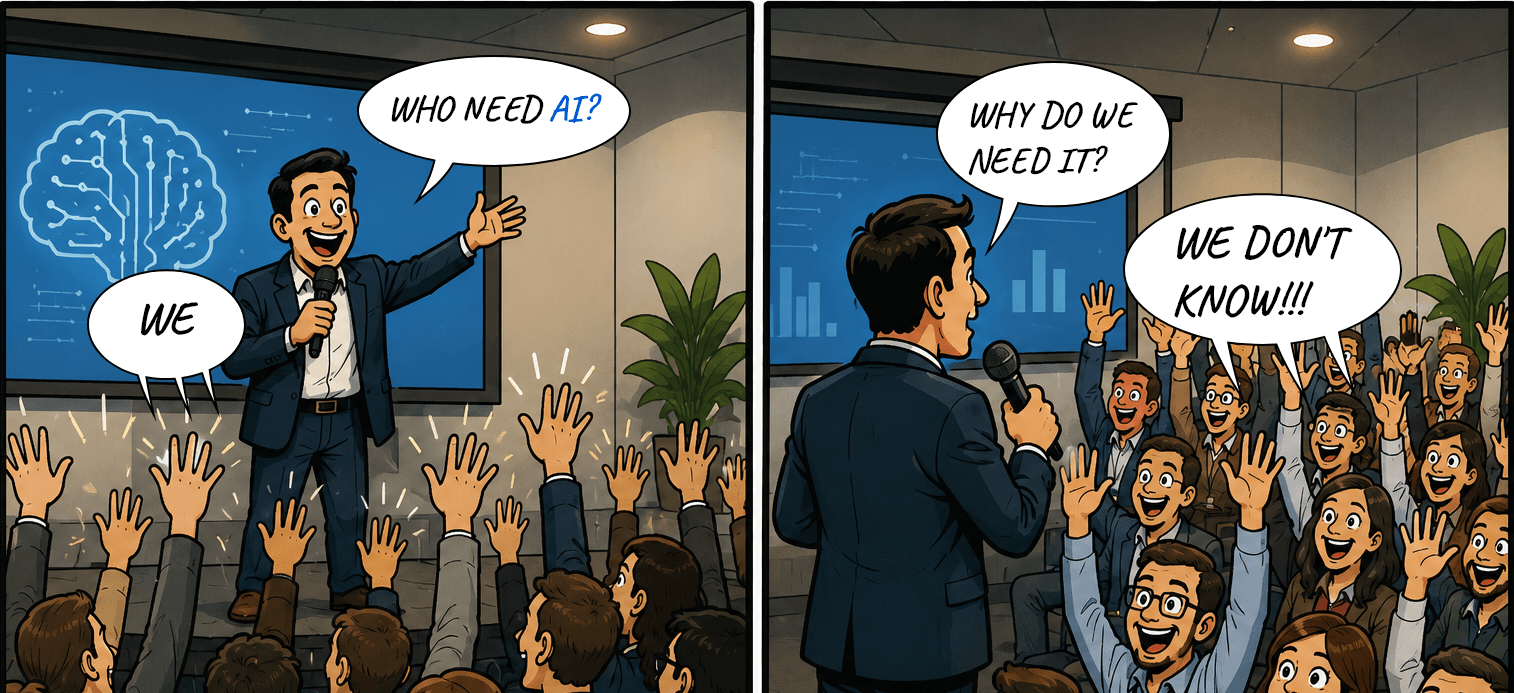
The reason is surprisingly simple. Most organizations start with the technology instead of the problem. They become fascinated by what AI can do before they understand what they need it to accomplish. As a result, conversations are dominated by capabilities rather than outcomes. Teams spend their time exploring features, models, and possibilities while paying far less attention to the business challenges those technologies are supposed to address. The outcome is predictable: impressive demonstrations that fail to translate into meaningful results.
The Wrong Question
One of the most common mistakes organizations make is asking the wrong question. The discussion often begins with, “What can AI do for us?” On the surface, this seems reasonable. After all, understanding the capabilities of a technology is important. However, this question naturally shifts attention toward the technology itself rather than the problem it is meant to solve. Teams begin brainstorming use cases, experimenting with prototypes, and searching for opportunities to showcase AI, even when no meaningful business need exists.
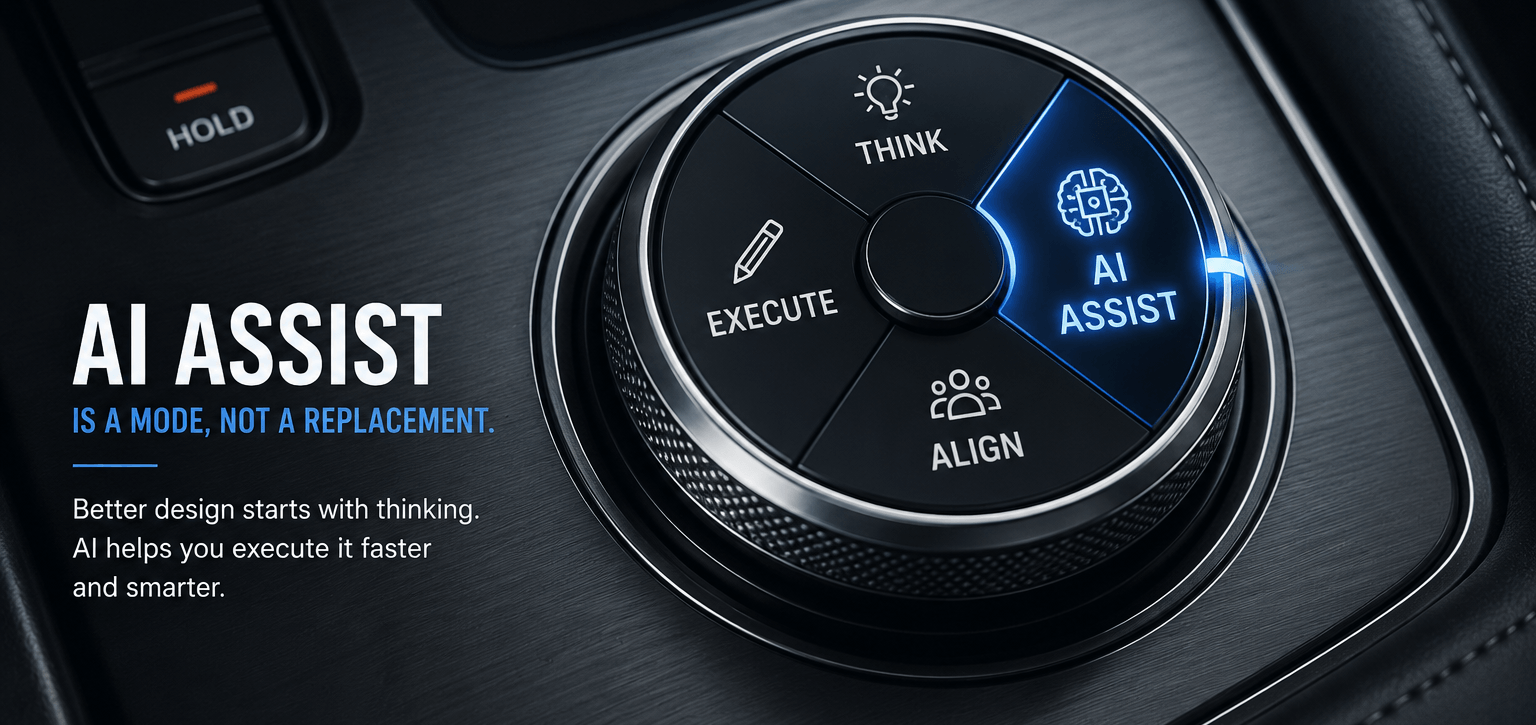
A far better question is, “What business problem becomes easier, faster, cheaper, or more accurate because of AI?” This immediately changes the focus of the conversation. Instead of starting with the tool, organizations start with the outcome. The objective is no longer to add AI to a product. The objective becomes improving a process, reducing friction, eliminating waste, increasing consistency, or creating better customer experiences. AI may be part of the solution, but it is no longer the destination.
This distinction may seem subtle, but it determines whether an initiative becomes a valuable business investment or simply another technology experiment.
When the Tail Starts Wagging the Dog
Many AI initiatives fail because organizations reverse the natural order of product and business decision-making. Instead of identifying a problem and then evaluating whether AI can help solve it, they decide that AI must be part of their strategy and then search for places to apply it. The tail starts wagging the dog.
This pattern is not unique to AI. We have seen it repeatedly with emerging technologies. Organizations rushed to build mobile applications because competitors had mobile applications. They pursued digital transformation because everyone was talking about digital transformation. They experimented with blockchain because it was considered the future. In each case, some organizations created tremendous value while many others invested significant resources with little to show for it. The difference was rarely the technology itself. The difference was whether the technology was connected to a genuine business need.
Today, many products include AI features primarily because AI has become a marketing requirement. Product teams feel pressure to demonstrate innovation. Leadership wants reassurance that the company is keeping pace with industry trends. Investors expect to hear an AI story. Customers are increasingly conditioned to look for AI capabilities. In this environment, adding AI can become an objective in itself rather than a means to achieve a business outcome.
Unfortunately, customers rarely care about the technology. They care about whether the product helps them accomplish their goals. A feature that sounds impressive but adds friction, complexity, or confusion is still a poor feature, regardless of how sophisticated the underlying technology may be.
The Hidden Cost of Unnecessary AI
There is an assumption that adding AI is inherently beneficial. In reality, every feature carries a cost. New functionality introduces complexity. It increases maintenance requirements. It creates additional training needs for users and employees. It expands testing requirements and support obligations. It often adds operational costs associated with infrastructure, monitoring, and model management.
An AI feature that does not create measurable value is not simply neutral. It becomes a burden. It consumes resources that could have been invested elsewhere. It increases product complexity without improving outcomes. It creates more things that can fail, more things users must understand, and more opportunities for confusion.
This is particularly important from a user experience perspective. My long-held belief has been that products should help people achieve their goals with the least possible effort. If someone is sending an email, they should be able to send it quickly. If someone is shopping online, they should be able to find and purchase what they need efficiently. If someone is looking for information, they should be able to understand it without unnecessary obstacles.
The purpose of the product is to facilitate the user's objective, not to showcase the capabilities of the technology behind it.When AI is introduced without a clear purpose, it often does the opposite. Instead of simplifying the experience, it complicates it. Instead of accelerating outcomes, it slows them down. Instead of removing friction, it creates new forms of friction.
The Best Technology Is Often Invisible
One of the lessons that experienced product and UX professionals learn is that the best technology is often invisible. Users rarely celebrate the sophistication of the underlying systems. They celebrate the outcomes those systems enable. Customers recommend products because they save time, reduce frustration, improve results, or make tasks easier to complete. They rarely recommend products because they use a particular algorithm or machine learning model.
This is where many AI initiatives go wrong. The AI becomes the feature rather than the mechanism. The organization wants users to notice the technology instead of benefiting from it. Yet the most successful technology implementations are often those that quietly improve workflows without demanding attention. Users may not even realize AI is involved, but they appreciate the improved experience.
If users spend more time learning how to use an AI feature than they save from using it, the feature has failed. It does not matter how advanced the technology may be. Success should be measured by the outcome, not by the sophistication of the implementation.
Most AI Failures Are Actually Problem Definition Failures
A common explanation for failed AI projects is that the technology is still immature. While there are certainly technical limitations, this explanation often misses the larger issue. In many cases, the technology works exactly as designed. The failure occurs because the organization never clearly defined the problem it was trying to solve.
Leadership decides the organization needs an AI initiative. The responsibility is delegated to teams that may have limited understanding of either AI or the business challenge. Demonstrations are created. Presentations are delivered. Stakeholders become excited about the possibilities. Yet when the time comes to deploy the solution, uncertainty emerges. Nobody can clearly explain how success will be measured, what process is being improved, or why customers would care.
This is fundamentally a problem-definition failure rather than a technology failure. AI becomes the answer before anyone has agreed on the question.
Gartner's Hype Cycle provides a useful lens through which to view this phenomenon. Emerging technologies often experience a surge of enthusiasm as organizations imagine their transformative potential. Expectations rise rapidly, adoption accelerates, and companies rush to participate. Eventually, reality exposes the gap between theoretical capability and practical value. The organizations that ultimately benefit are not necessarily the ones that adopted the technology first. They are the ones that successfully connected the technology to real business outcomes and operational workflows.
Where AI Creates Real Value
The most successful AI implementations rarely focus on showcasing AI. Instead, they focus on improving a specific workflow. The technology becomes valuable because it is embedded into a process where its impact can be measured and observed.
Hiring provides a useful example. Traditional recruitment often requires significant manual effort. Recruiters review large volumes of resumes, coordinate interviews, assess candidates, and manage complex hiring pipelines. AI can contribute meaningful value by helping screen resumes, conduct structured assessments, improve consistency, and reduce administrative workload. The benefits are measurable. Recruiters spend less time on repetitive tasks. Candidate evaluation becomes more consistent. Hiring decisions can be made more quickly and with better information.
Notice that the value does not come from having AI. The value comes from achieving better hiring outcomes. AI simply happens to be an effective mechanism for improving the process.
This distinction is important because it highlights where organizations should focus their attention. The objective should never be to maximize AI usage. The objective should be to maximize business outcomes.
What Leaders Should Ask Instead
Business leaders evaluating AI initiatives should adopt a more disciplined approach. Instead of asking what AI can do, they should ask what business problem they are trying to solve. They should define success before discussing technology. They should identify the process being improved and establish clear measures for evaluating results. Most importantly, they should challenge themselves to determine whether the initiative would still be worth pursuing if AI were not the fashionable solution of the moment.
These questions are often less exciting than discussions about emerging technology, but they lead to far better decisions. They shift the focus from capability demonstrations to business outcomes. They encourage organizations to invest in solutions rather than trends.
Final Thoughts
Artificial Intelligence is one of the most important technological developments of our time. Its potential is enormous, and organizations that apply it thoughtfully will undoubtedly create significant value. However, the presence of AI does not automatically make a product better, a process more efficient, or a business more successful.
The organizations creating meaningful value with AI are not chasing technology for its own sake. They are solving real problems. They are improving workflows. They are reducing friction. They are delivering measurable outcomes. In other words, they are treating AI as a tool rather than a destination.
Technology should always serve the business objective. The business objective should never exist to justify the technology. When leaders remember this principle, they stop being impressed by demonstrations and start focusing on outcomes. That is where real value is created, and that is where AI delivers its greatest impact.