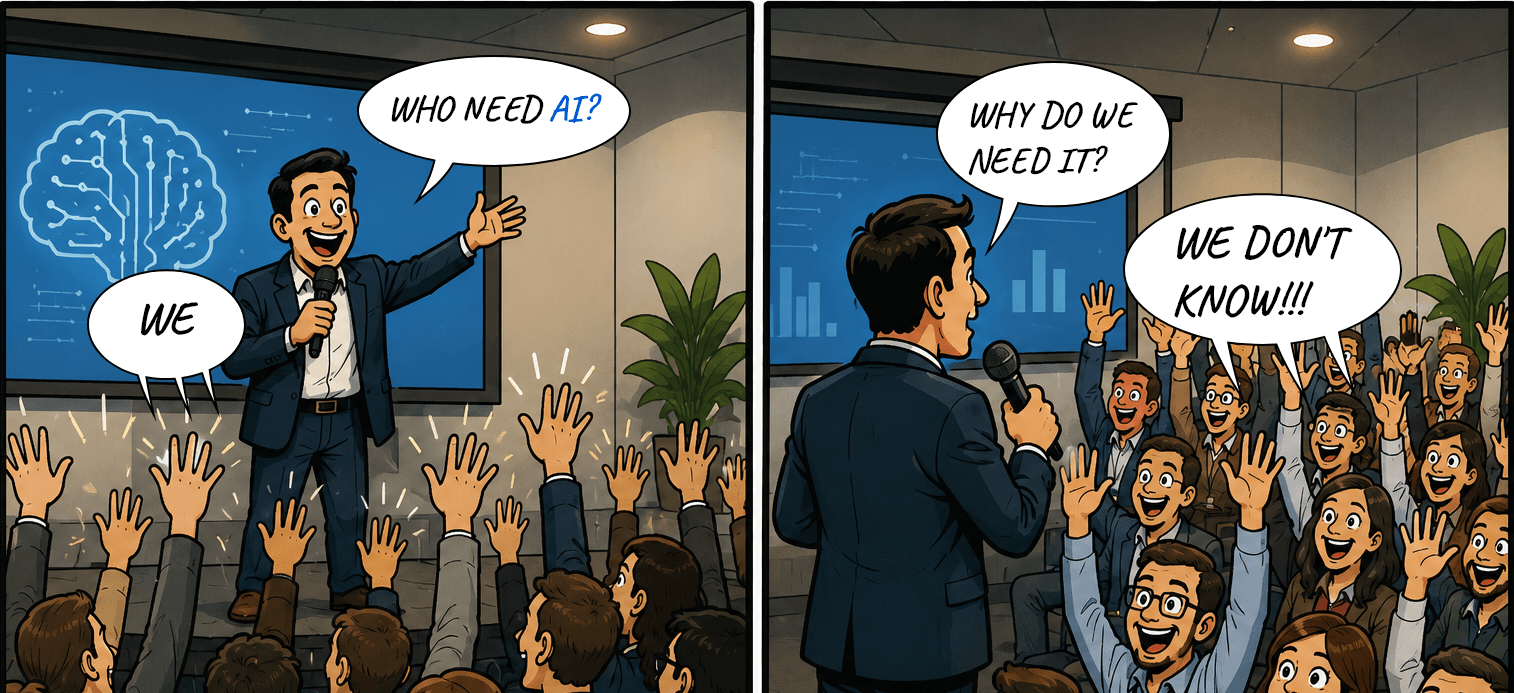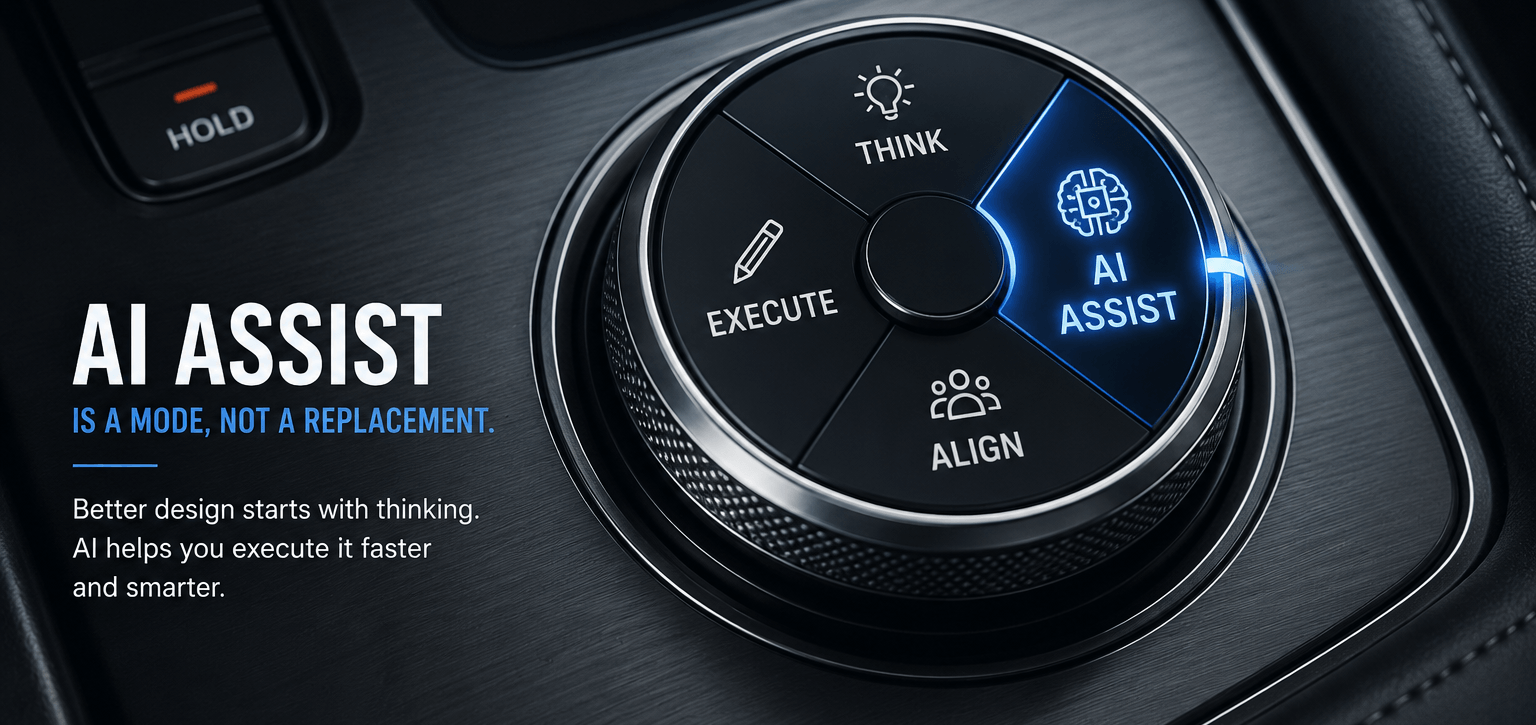
My view is simple. AI is not replacing designers. It is changing what creates value in design.
The biggest misconception is that AI can compress weeks of design work into fifteen minutes. It can certainly accelerate parts of the process. It can generate interface concepts, create realistic content, produce code, summarize research, and automate repetitive tasks. However, good design was never just about producing screens. The most valuable part of design has always been understanding the problem, making decisions, balancing trade-offs, and aligning people around a solution. Those activities still require human judgment.
The designers who are worried about losing their jobs are often looking at the wrong part of the profession. AI is not creating a divide between designers who think and designers who execute. That divide has always existed. Some designers primarily focus on execution. Give them a problem and they will create beautiful screens. Other designers spend more time understanding the business context, identifying root causes, challenging assumptions, and helping teams make better decisions. The second group has always created more value because they influence outcomes rather than simply producing deliverables.
What AI changes is the relative importance of these skills. When execution becomes faster and cheaper, thinking becomes more valuable. A designer who understands the problem can use AI to execute faster. A designer who does not understand the problem simply produces the wrong solution more efficiently.
AI Compresses Execution, Not Judgment
Much of the discussion around AI focuses on speed. People proudly demonstrate how they created a landing page in fifteen minutes or generated a complete application interface from a few prompts. While those demonstrations can be impressive, they often confuse output with outcomes.
The difficult part of most design projects is not drawing screens. The difficult part is determining what should be built in the first place. Who is the customer? What problem are we solving? What information matters? Which workflows are critical? What compromises are acceptable? How do we align stakeholders with different priorities? These questions cannot be answered by a prompt alone because they require context, experience, and business understanding.
AI can help explore possibilities, but it cannot assume responsibility for the decisions. Someone still has to evaluate options, understand consequences, and choose a direction. That responsibility remains with designers, product leaders, founders, and teams.
How AI Has Changed My Own Design Process
The biggest impact I have seen from AI is not in strategy or ideation. It is in execution. Traditionally, many projects followed a familiar path. The designer created screens in Figma, developers translated those screens into code, and some level of interpretation happened during implementation. Even with detailed specifications, things were often lost in translation.
Today, AI allows me to deliver much more than static designs. In many cases, I can provide working HTML prototypes instead of only handing over design files. This reduces the gap between design intent and implementation. The result is not only faster delivery but often a more accurate outcome because fewer assumptions are introduced during handoff.
AI is also extremely useful for the supporting work that surrounds design. Instead of filling prototypes with Lorem Ipsum, I can generate realistic content. Instead of manually creating dozens of fictional customer records for a data table, I can generate realistic names, addresses, emails, and business data. None of these activities are core design work, but they improve the quality of prototypes and make them more believable during reviews and stakeholder discussions.
These are examples of AI acting as a multiplier. The tool is not replacing design thinking. It is removing friction from the process so more time can be spent on activities that actually create value.
Why Some AI-Generated Design Work Looks Generic
One reason people become disappointed with AI is that they expect great results from generic prompts. Asking AI to create a landing page for a dry-cleaning company will usually produce something that looks acceptable but unremarkable. The output often reflects the quality of the input.
This highlights an important reality. AI works best when combined with expertise. An experienced designer can guide the process, provide constraints, evaluate alternatives, and refine the results. Someone with little understanding of design principles, user behavior, or business goals will often accept the first answer generated by the system. As a result, the work may look polished while remaining fundamentally mediocre.
The same tool in the hands of two different people can produce dramatically different outcomes. The difference is not the technology. The difference is the experience, judgment, and knowledge of the person using it.
What AI Can and Cannot Improve
Rather than debating whether AI will replace designers, a more useful question is where it creates meaningful leverage and where it has limited impact.
| Activity | AI Impact | Why |
|---|---|---|
| Generating placeholder content | High | Removes repetitive work and creates more realistic prototypes. |
| Creating sample data | High | Improves the realism of dashboards, tables, and business applications. |
| Secondary research | High | Accelerates information gathering and synthesis. |
| UI exploration and variations | High | Allows designers to evaluate more options in less time. |
| Documentation and specifications | High | Reduces administrative effort and speeds communication. |
| Prototype development | High | Enables designers to create more complete and interactive deliverables. |
| Research interpretation | Moderate | Can identify patterns, but human judgment is still required to understand context. |
| Product strategy | Moderate | Can support decision-making but cannot own business outcomes. |
| Problem framing | Low | Requires understanding organizational context and business realities. |
| Stakeholder alignment | Low | Depends on trust, influence, and communication between people. |
| Prioritization decisions | Low | Requires balancing business, user, technical, and organizational constraints. |
| Organizational politics and change management | Very Low | Human relationships remain central to these activities. |
What This Means for Bootstrap Founders
For founders, AI creates an opportunity to build leaner teams without necessarily reducing quality. A small design team equipped with the right tools can produce the output that previously required a much larger group. This changes the economics of product development and allows startups to move faster with fewer resources.
However, founders should be careful not to assume that AI eliminates the need for experienced designers. If anything, it increases the value of designers who can think strategically. A founder does not benefit from a larger volume of screens. They benefit from better decisions, clearer priorities, stronger customer understanding, and more effective products. AI helps with execution, but those outcomes still depend on human expertise.
What This Means for Design Leaders
Many organizations are encouraging teams to adopt AI. The mistake is treating AI usage as the goal. The goal should be better outcomes.
If a task previously required five days and AI allows it to be completed in three, that is a meaningful improvement. What matters is the result, not whether every step involved an AI tool. Forcing teams to use AI simply to satisfy a mandate often leads to unnecessary work and unintended consequences.
A better approach is to give designers the freedom to decide where AI creates value within their own process. Experienced professionals are usually best positioned to determine which activities should be automated and which require deeper human involvement.
The More Things Change, the More They Remain the Same
Every major technology arrives with predictions that it will completely transform how businesses operate. We heard those claims when the internet became mainstream. We heard them again when smartphones reshaped consumer behavior. More recently, blockchain and IoT were presented as technologies that would fundamentally alter every industry. While each of these technologies created real value, none of them changed the underlying reality that organizations still need to understand customers, solve problems, make decisions, and execute effectively.
AI should be viewed through the same lens. It is a powerful tool. It is already making designers more productive. It is helping teams move faster and reducing the effort required for many routine activities. At the same time, it does not remove the need for judgment, experience, critical thinking, or business understanding.
The designers who thrive over the next decade will not be the ones who resist AI. They will also not be the ones who blindly follow the hype. They will be the ones who learn how to use AI to amplify their expertise while continuing to do the difficult work of understanding people, solving problems, and making good decisions.
In the end, AI is not replacing designers. It is increasing the value of designers who know how to think.