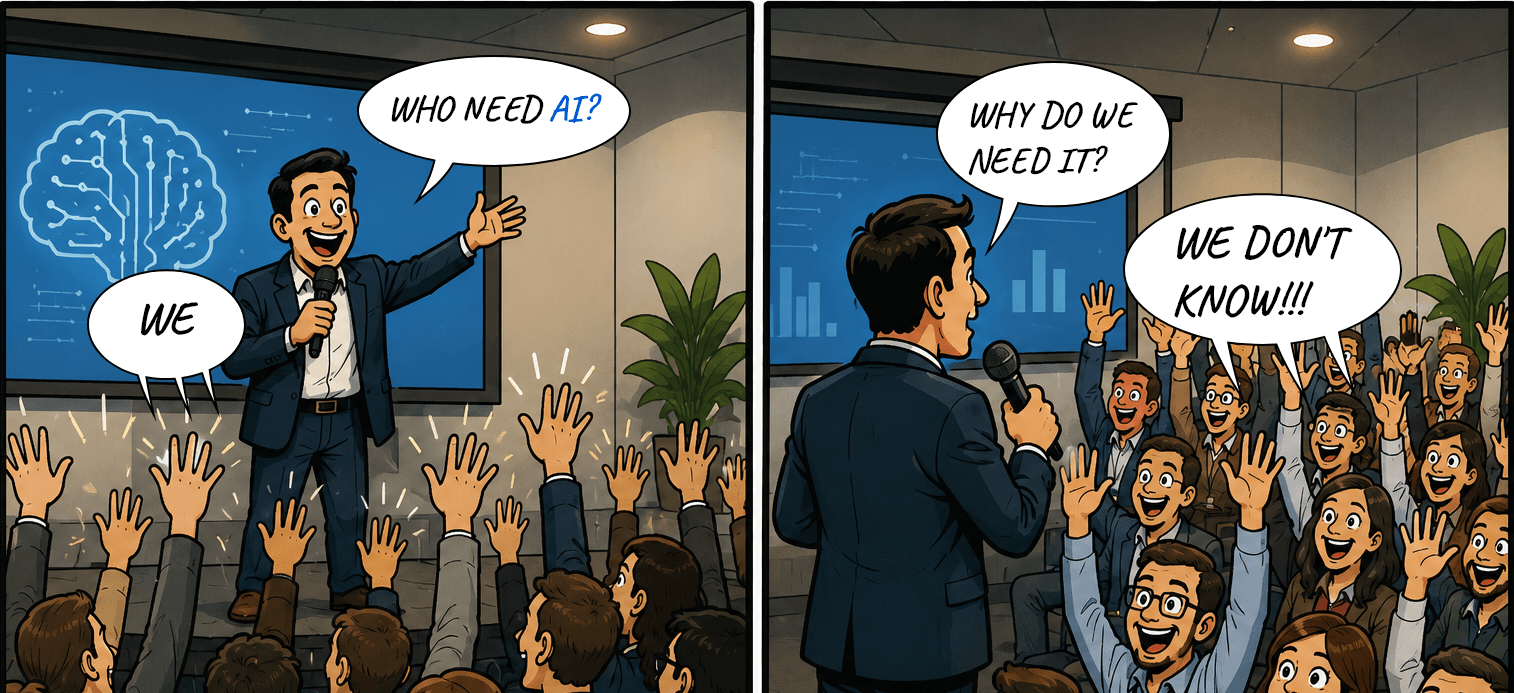
Product teams are surrounded by ideas. Customers suggest features. Sales teams request enhancements. Executives champion initiatives they believe will create growth. Founders wake up with insights in the middle of the night. Everyone has an opinion about what should be added next.
The problem is not a shortage of ideas. The problem is deciding which ideas deserve a place in the product.
Many roadmap discussions begin with the wrong question: "Is this a good idea?" While that question matters, it is not the most important one. A much better question is: "Does this idea belong in this product?"
Validation is not about proving an idea is good. Validation is about proving an idea belongs inside this specific product.
This distinction may appear subtle, but it changes the entire conversation. Good products are rarely built by collecting every good idea. They are built by protecting a clear idea and ensuring that every addition strengthens it rather than dilutes it.
Every Product Is a Promise
At its core, every product exists to fulfill a need. It makes a promise to its users. That promise may be helping teams collaborate, helping businesses manage finances, helping professionals find jobs, or helping customers complete a task more efficiently.
When evaluating a new feature, the first question should not be whether customers might use it. The first question should be whether it helps the product fulfill its promise more effectively.
A worthwhile feature generally does one of three things:
- It helps solve the core problem better.
- It removes friction from solving that problem.
- It addresses a closely related need that naturally emerges from the core problem.
If a feature does none of these things, it may still be a good idea. It simply may not belong in that particular product.
Good Ideas Can Be Dangerous

Bad ideas are easy to reject. Good ideas are much harder.
A good idea usually comes with a compelling argument. A customer requested it. A stakeholder believes it will add value. A competitor already offers something similar. The idea appears useful and reasonable.
That is precisely why good ideas can be dangerous.
Teams often evaluate features in isolation. Individually, each feature appears valuable. Collectively, however, they can slowly erode the clarity of the product.
Over time, the product becomes more complicated. The user experience becomes less focused. New users struggle to understand what the product is actually designed to do. The original value proposition becomes buried beneath a growing collection of features that each seemed justified when considered independently.
The greatest threat to many products is not bad ideas. It is the accumulation of good ideas that solve different problems for different audiences.
Protecting a product requires discipline. It requires saying no, not because an idea lacks merit, but because the product cannot afford to lose focus.
Some Features Are Actually New Products

One of the most common mistakes in product development is assuming that every valuable capability should become a feature.
In reality, some features are not features at all. They are the beginnings of entirely different products.
I once observed a product team invest significant effort into a sophisticated capability requested by a secondary audience. The capability itself was valuable. The problem was that it solved a different problem for a different group of users.
What initially appeared to be a roadmap enhancement gradually expanded into a substantial body of work with its own workflows, requirements, reporting needs, and user expectations.
The feature was not wrong. It simply belonged somewhere else.
This is an important distinction. Sometimes the correct response to a good idea is not to reject it. Sometimes the correct response is to recognize that it deserves its own product strategy rather than being attached to an existing one.
Not every idea needs to be rejected. Some ideas simply belong in a different conversation.
Repetition Is a Form of Validation
The founders of Basecamp have shared an interesting principle. When people suggest new features, they do not immediately treat every request as something that belongs on the roadmap.
The reasoning is straightforward. If a problem genuinely matters, there is a good chance it will surface repeatedly. Different customers will describe it in different ways. Similar requests will emerge from multiple conversations. Patterns will begin to appear.
The lesson is not that ideas should never be documented. The lesson is that frequency matters.
A single request is feedback.
Repeated requests are evidence.
When the same need continues to emerge across customers, contexts, and conversations, it becomes much easier to determine whether the issue is fundamental to the product experience or simply an isolated preference.
A Simple Test for Roadmap Decisions
When founders and product managers are evaluating potential roadmap items, it helps to reduce the discussion to its simplest form.
Imagine explaining the product to a five-year-old. What problem does it solve? What is the simplest possible description of its purpose?
Once that definition is clear, every proposed feature can be evaluated against it.
- Does this idea strengthen the product's core promise?
- Does it help users achieve the primary outcome more effectively?
- Does it solve a naturally related problem?
- Would the product be meaningfully weaker without it?
If the answer is yes, the feature deserves serious consideration.
If the answer is no, it may still be a good idea. It simply may not belong in the roadmap.
The Roadmap Is Not a Collection System

Many teams treat roadmaps as repositories for ideas. Every request gets captured. Every suggestion gets discussed. Every opportunity gets preserved for future consideration.
A better way to think about the roadmap is as a protection system.
Its purpose is not to collect ideas. Its purpose is to protect the integrity of the product.
The roadmap should ensure that time, money, and attention are invested in strengthening the product's central promise rather than chasing every attractive opportunity that appears along the way.
The most successful products are often not the ones that said yes to the most ideas. They are the ones that understood which ideas deserved a place in the product and which ideas belonged somewhere else.