
Why You're Stuck in Execution
1. You Understand Users, But Not the Business
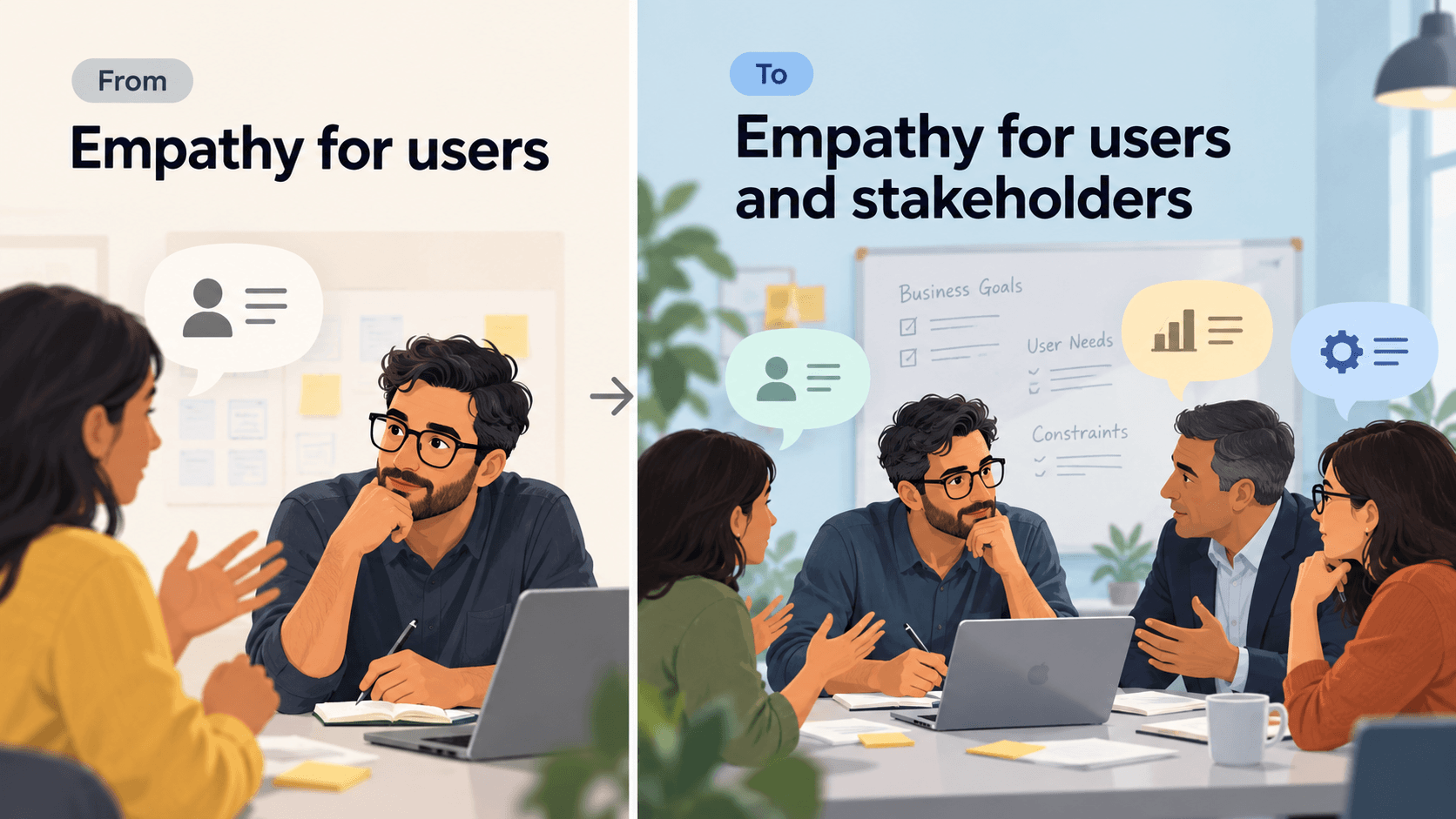
Empathy is fundamental to UX design. We're taught to understand users, uncover their needs, and advocate for their interests. But how often are we taught to apply the same empathy to our stakeholders, managers, and business leaders?
Think about it. You know how to ask what frustrates your users, what they need, and how to improve their experience. But do you know what pressures your stakeholders face, what business outcomes they're accountable for, and what problems they're trying to solve?
This matters because your stakeholders aren't evaluating your work solely through the user's eyes. They're also thinking about revenue, conversion, customer retention, operational costs, and business growth.
When you understand only one side of the problem, you may struggle to explain how your work contributes to the other. Your stakeholders might appreciate your design skills without recognising your ability to help solve business problems.
Empathy shouldn't stop at the person using the product. It should extend to the people responsible for making the product succeed.
2. You Explain Design, Not Business Value
Consider how you present your work. You might explain that you've simplified a checkout process, made the interface more intuitive, or reduced friction for users. These are valid design improvements, but they don't necessarily communicate the full value of your work to the business.
Now consider the same work from a business perspective.
You explain that reducing friction in checkout is intended to lower cart abandonment and increase completed purchases. You identify the relevant metrics and, where possible, measure the results.
The design work hasn't changed. What has changed is how you explain its value.
This is an important distinction. You don't need to abandon user-centred design or turn every design review into a financial presentation. You need to connect the experience you're improving to the outcome the organisation wants to achieve.
If you consistently talk only about usability and interface improvements, stakeholders may understand what you've delivered without understanding why it matters to the business. Over time, that can limit how they perceive your contribution.
3. You Demonstrate Execution More Often Than Strategic Thinking
Over the later part of my career, I observed a distinction between designers who were trusted to execute and those who were trusted to help determine the solution.
The first group was excellent at turning a defined problem into a well-designed product experience. The second was involved earlier, helping the team understand the problem, challenge assumptions, explore alternatives, and decide what should be built.
Both capabilities are valuable. The difficulty arises when you want to progress into a strategic role but are consistently perceived as someone who executes decisions rather than helps make them.
Ask yourself:
- Are you involved when the team decides which problems to solve, or only after those problems have been defined?
- Do you question the assumptions behind a brief, or immediately start working on the requested solution?
- Can you explain the business reasoning behind your recommendations, or do you focus primarily on the design rationale?
These questions aren't intended to blame designers for being excluded from strategic discussions. Some organisations restrict design involvement regardless of a designer's capabilities. But where you have the opportunity to contribute, your behaviour and communication can influence whether others recognise your strategic thinking.
The Lesson I Learned Late in My Career
I made this mistake myself. For much of my UX career, I focused on explaining the value I created for users and designers. It was only when I started working with founders and smaller organisations that I realised I also needed to explain how my work benefited the business. The questions they asked forced me to reconsider how I communicated my value. That realisation changed how I approached my work and how I presented my services.
How to Become a Strategic Contributor
1. Understand the Business Problem Before Designing
When you receive a brief, resist the urge to jump straight into the solution. First, understand why the work matters and what the organisation is trying to achieve.
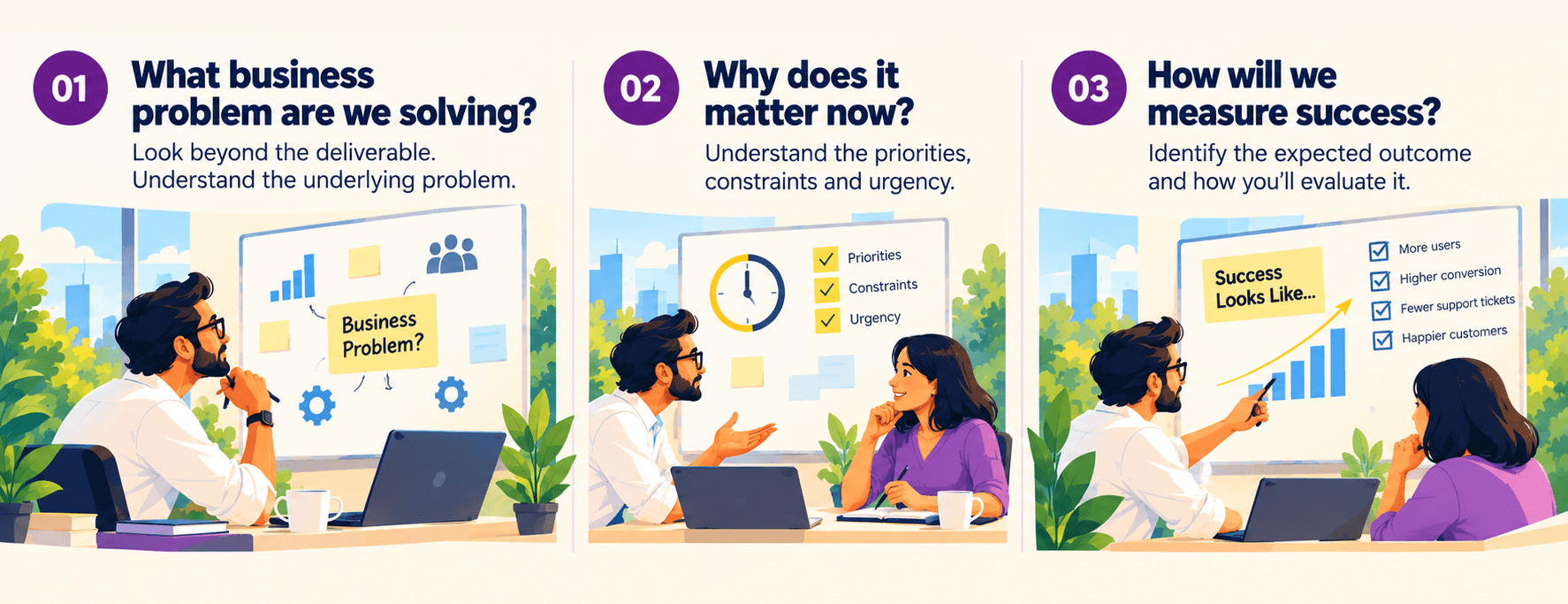
Start by asking three questions:
- What business problem are we trying to solve? Understand the reason behind the request, not just the requested deliverable.
- Why does this problem matter now? Understand the priorities, constraints, and circumstances driving the work.
- How will we know if we've solved it? Identify the outcomes the team expects and how success might be measured.
These questions help you understand the context in which your design decisions will be made. They also demonstrate that you're interested in solving the underlying problem, not merely completing an assignment.
2. Connect User Needs to Business Outcomes
When presenting a design recommendation, explain both what it does for the user and why that matters to the business.
For example, a clearer checkout experience can reduce confusion for customers. The business objective might be to reduce cart abandonment and increase completed purchases.
Learn which metrics matter to your product. Depending on the problem, these might include conversion, retention, task completion, customer satisfaction, or support costs.
You don't need to claim that every design change will increase revenue. Be clear about what you know, what you expect, and what needs to be measured. The goal is to demonstrate that you understand the relationship between the user experience and the business outcome.
3. Ask Better Questions Before Designing
Strategic thinking often becomes visible before you produce a single design.
Instead of immediately asking how to improve an interface, ask whether the team is solving the right problem. Explore the assumptions behind the brief and consider whether there are alternative ways to achieve the intended outcome.
For your next project, try asking:
- What evidence tells us this is the problem we should solve?
- Are we addressing the root cause or just a visible symptom?
- What alternatives should we consider before committing to this solution?
- What trade-offs are we making, and who will be affected by them?
You don't need to challenge every decision or turn every conversation into a debate. The objective is to contribute useful thinking that helps the team make better decisions.
4. Demonstrate Outcomes, Not Just Deliverables
Completing a redesign, delivering a prototype, or launching a new feature tells stakeholders what you've produced. It doesn't necessarily tell them what value the work created.
Where possible, follow up on the outcomes of your work. Did users complete tasks more successfully? Did conversion improve? Did support requests decrease? Did the change solve the problem the team originally identified?
If the results haven't been measured, identify what should be measured and how you would evaluate success. You can still demonstrate strategic thinking by connecting your decisions to intended outcomes and proposing a sensible way to validate them.
Over time, this helps stakeholders see more than your ability to deliver design work. It helps them understand how you reason about problems, evaluate decisions, and contribute to results.
It's Time to Broaden Your Empathy
If you feel stuck in your UX career, don't immediately assume that you need another design tool, certification, or specialised skill. First, examine whether the people around you understand the full value you can bring.
Do they see someone who can make an existing solution better? Or do they also see someone who can understand a business problem, challenge assumptions, and help determine what should be built?
You cannot control every organisational decision, and better communication alone won't guarantee a promotion or salary increase. But you can make your strategic thinking more visible by understanding business objectives, connecting user needs to business outcomes, and contributing before the solution has been decided.
The next time you're given a design brief, resist the urge to jump straight into the solution. Understand the problem first. Ask what the business is trying to achieve. Connect the user's needs to that objective. Make your reasoning visible.
You may not control whether you're invited into the strategy room. But you can start demonstrating that you're capable of contributing once you're there.