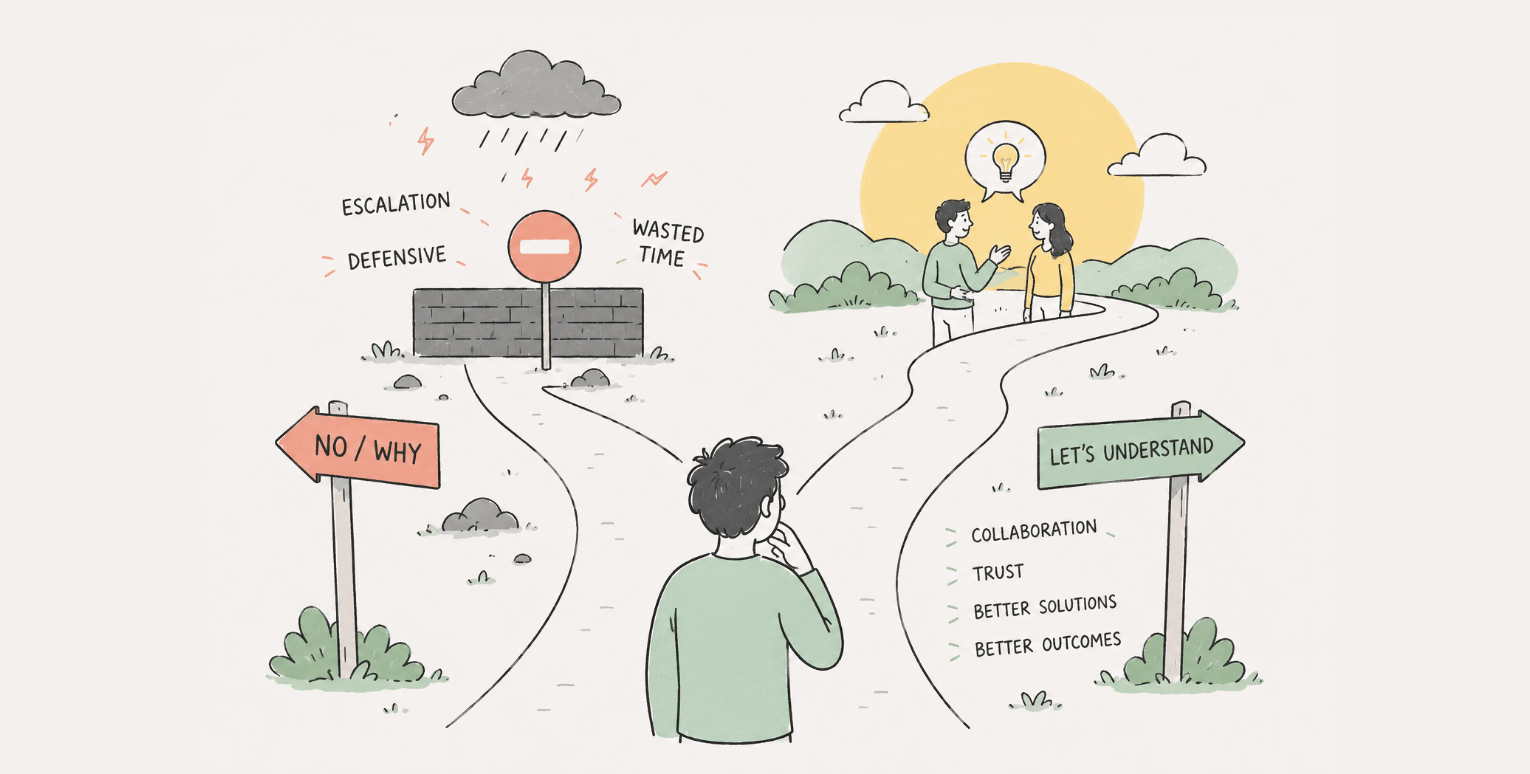
Panic is one of the most natural human responses. It appears long before reason has had a chance to catch up. We don't get to choose whether we feel that first wave of panic. What we do get to choose is what happens next. Do we let that first reaction dictate our actions, or do we pause long enough to understand what we're actually responding to?
Panic is contagious. It rarely begins with a crisis. More often, it begins with a sentence.
"We have a problem."
"The client isn't happy."
"The project is changing."
Within seconds, speculation fills the gaps that facts haven't yet occupied. Assumptions become conclusions. Conversations become rumours. Urgency quietly transforms into anxiety, and before long an entire team is making decisions from a state of fear rather than understanding.
I've watched this happen throughout my career, and it taught me a simple rule that has shaped the way I lead.
I don't ask other people to carry my panic until I've verified that the situation deserves it.
That doesn't mean I never feel uncertain. It means I've learned that my first emotional reaction is not evidence. It is simply a signal that I need to understand the situation before I decide how everyone else should respond to it.
A Lesson That Followed Me Throughout My Career
Years ago, after I accepted a leadership role, my new manager spoke with someone who had worked closely with me in the past. One observation stayed with me. He said that when everyone else lost their composure and rushed around trying to solve everything at once, I remained calm enough to keep solving problems.
At the time, I took it as a compliment. Looking back, I think he was describing something much more important than temperament.
Over the years, different people have made remarkably similar observations. More than once, members of my team have told me that whenever they felt overwhelmed, they would come to me, and they always left those conversations calmer than when they arrived.
It wasn't because I reassured them that everything would be fine.
It was because together we reduced a seemingly impossible problem into something understandable and manageable.
People Don't Need Reassurance. They Need Clarity.
People rarely become calmer because someone tells them to relax.
They become calmer when confusion is replaced with clarity.
I once worked with someone who was energetic, enthusiastic and constantly distracting the people around him. Many saw the behaviour as the problem. I saw something different.
Once we clarified his priorities, gave him a clear roadmap and focused his energy on meaningful work, the behaviour largely disappeared.
We hadn't changed his personality.
We had changed the conditions in which he was working.
That experience reinforced something I had been learning for years.
Most behavioural problems are often thinking problems in disguise.
The Difference Between Panic and Urgency
Many teams operate like this:
- Something changes.
- People imagine the worst.
- The panic spreads.
- Only then does everyone try to understand what actually happened.
Over time, I've learned to reverse that order.
The CALM Framework


The next time you find yourself in a situation where everyone around you is panicking, resist the urge to react immediately. Instead, take a deep breath and walk yourself through the CALM framework. It won't eliminate uncertainty, but it will help you replace emotional reactions with thoughtful decisions.
CALM
-
C — Clarify the Situation
What has actually happened? Separate observable facts from assumptions, rumours and speculation. -
A — Assess the Impact
How serious is the problem really? What are the immediate consequences, and what can wait? -
L — Limit the Problem
Reduce the problem to something understandable and manageable. Don't let one issue become ten imagined ones. -
M — Move with Appropriate Urgency
Respond with the level of urgency the evidence justifies—not the urgency your emotions suggest.
Panic is a natural human response. Spreading panic is a leadership decision. Before you press the panic button for everyone else, remember to stay CALM.
Notice that the goal isn't to suppress emotion.
The goal is to prevent uncertainty from becoming organizational truth before reality has been established.
Urgency and panic are not the same thing. Urgency sharpens execution. Panic narrows thinking. Urgency focuses people on what matters most.
Panic makes everything feel equally important.
Leaders Teach Teams How to React
One of the most damaging leadership habits I've observed is the creation of artificial urgency. Some leaders unintentionally teach their teams that every issue is critical, every meeting is an emergency and every message must sound alarming to demonstrate commitment.
Teams adapt surprisingly quickly.
When panic is rewarded, people learn to perform panic.
When blame is rewarded, people learn to hide mistakes.
When clarity is rewarded, people learn to think.
That is culture. Not slogans on walls. Not values written into presentations. Simply the behaviours leaders reinforce every day.
Every leader trains the emotional habits of the people around them, whether they intend to or not.
Before You Press the Panic Button
Looking back, I don't think the most valuable thing I've learned is how to remain calm. The more valuable lesson is knowing that leaders don't simply solve problems. They shape the state of mind in which those problems are solved.
Before sending the alarming email, calling the emergency meeting or announcing that everything has gone wrong, I now ask myself four simple questions.
- What do I actually know?
- What am I assuming?
- What requires action right now?
- Am I communicating verified urgency, or am I asking my team to carry the weight of my uncertainty?
Leadership is not the absence of panic. It is the discipline to ensure that panic is earned before it becomes contagious.