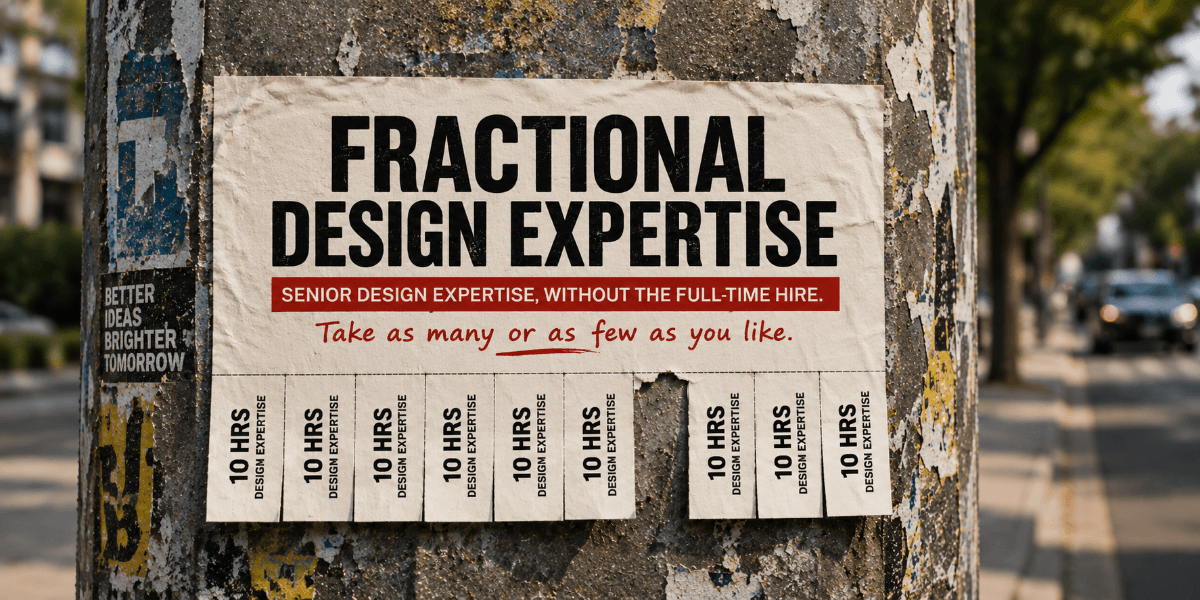
Why a ₹5 Lakh Fractional Engagement Can Save You ₹45 Lakhs
“That is a lot of experience. Must be out of our budget.” If that's what you think when considering engaging a senior UX expert, you're looking at it the wrong way. You are not spending ₹5 lakhs on expensive expertise. You are spending ₹5 lakhs to avoid a ₹50 lakh full-time hire.
Let's make the numbers simple.
Someone with the experience you need might cost around ₹50 lakh a year as a full-time hire. But suppose you have a project that needs that level of UX expertise and a fractional engagement costs ₹5 lakh.
You haven't spent ₹5 lakh instead of nothing.
You have potentially avoided spending ₹45 lakh on a full-time hire.
That is the basic economics of fractional UX leadership.
The question isn't whether you can afford a fractional UX leader. The question is whether you need that capability full-time.
It’s Not a Cost. It’s a Saving on What It Could Really Cost You.
A senior UX leader brings experience, judgment and the ability to work through ambiguity. But needing that experience for a particular problem does not automatically mean you need to employ that person for an entire year.
That distinction is easy to miss.
A full-time hire is a commitment to ongoing capacity. A fractional engagement is a way of accessing capability when you need it.
The work could involve articulating the problem statement, eliciting requirements, creating a PRD, conducting research, defining UX principles for the project, doing the actual UX work, or some combination of these.
The engagement is shaped around what the business needs rather than around creating a permanent position.
What Does the Engagement Cost?
In a direct comparison, an experienced person will cost more. That's simply a fact. But the value they bring can be disproportionately higher than the additional cost.
The difference can show up in a better product, happier clients, a more engaged design team and a shorter design cycle with significantly fewer iterations.
So the question isn't, “Why does this person cost more?”
It is, “What is that experience going to save me—and what will it help me achieve?”
The cost of the engagement still depends on the work. A clearly defined project may require less involvement. A complex problem involving ambiguity, research, stakeholder alignment, requirements and UX design may require considerably more.
The engagement changes with the work. The value comes from applying the right level of experience to it.
There Is More Than One Way to Engage a Fractional Leader
Project work is only one model.
You can also engage a fractional UX leader for a defined number of hours each week. That might be 10 hours, 20 hours, or whatever makes sense for the organisation.
This model is useful when you don't have one specific project that needs to be completed, but you do need access to senior UX thinking on an ongoing basis.
For example, a fractional leader might spend those hours:
- Mentoring and developing the design team
- Setting up or improving UX processes
- Reviewing the work produced by the design team
- Helping the team make difficult design decisions
- Providing senior UX direction and guidance
- Helping establish standards and ways of working
This can also change the economics of senior leadership.
Like you don't need to rent an entire office to get a professional workspace, you opt for co-wrking space taking the number of seats you need, and benefiting from the reception, Wi-Fi, meeting rooms, cafeteria and other facilities that would be expensive to provide on your own.
Fractional expertise works the same way. You don't need a senior UX expert full-time. You may need 10 or 20 hours a week. You get the level of expertise you need without carrying the cost of having that person available to you for the remaining hours.
You are only buying the capacity you need, while still getting the benefit of senior expertise.
When Fractional Is the Right Fit
Fractional leadership works particularly well when the need is substantial enough to require experience and judgment, but not substantial enough to justify a permanent full-time role.
It can make sense when:
- You have a defined project that needs senior UX expertise.
- Your existing team needs mentoring or guidance.
- You need someone to establish or improve your UX process.
- You want experienced eyes reviewing the work your team is producing.
- You have an important UX problem but don't yet need a full-time UX leader.
- You need specialist experience occasionally rather than continuously.
In each of these situations, the value is not in having another person permanently on the payroll. The value is in getting the right level of expertise applied to the problem.
When Fractional Is Not the Right Fit
Fractional leadership isn't always the answer.
If you need someone embedded in the organisation every day, managing a large design team, making continuous decisions, working closely with leadership and owning UX as an ongoing organisational function, you probably need a full-time leader.
The same applies when the workload is already consistent and substantial enough to occupy a senior person's time every week.
In those circumstances, hiring someone full-time may be the better decision.
Fractional leadership isn't about avoiding a full-time hire. It is about avoiding a full-time hire when the business doesn't actually need one.
Ask What Capability You Actually Need
Before deciding how to engage a senior UX leader, ask a few simple questions.
- Is this a one-off or occasional need rather than a recurring full-time workload?
- Does the problem require more depth or judgment than your existing team currently has?
- Would hiring someone full-time be overkill once this particular project is complete?
- Could the work be defined as a project, outcome or specific number of hours each week?
- Would getting this right materially affect the business?

If most of the answers are yes, a fractional engagement may be worth considering.
And the engagement doesn't have to look the same for every company.
You might need someone for a project. You might need 10 hours a week to mentor your team. You might need 20 hours a week to establish a UX function and review the team's work. Or you might need something in between.
The right question is not, "How do I hire a senior UX leader?"
It is:
"How much senior UX capability does my business actually need, and for how long?"
The Economics Become Clearer
Go back to the simple example.
Suppose a full-time senior UX leader costs ₹50 lakh a year.
Your project needs that level of expertise, but only for the duration of the project. A fractional engagement costs ₹5 lakh.
The ₹5 lakh is not necessarily a cheap alternative to a ₹50 lakh hire.
It is a different way of acquiring the capability you need.
And if you don't need that capability full-time, the difference can be ₹45 lakh.
The smartest hiring decision is not always about finding the right person. Sometimes it is about deciding how much of that person's expertise you actually need.
If you have a UX or product problem and aren't sure whether it warrants a full-time hire, send me what the project actually involves. I'll tell you honestly whether a fractional engagement is the right fit and roughly what it would take.