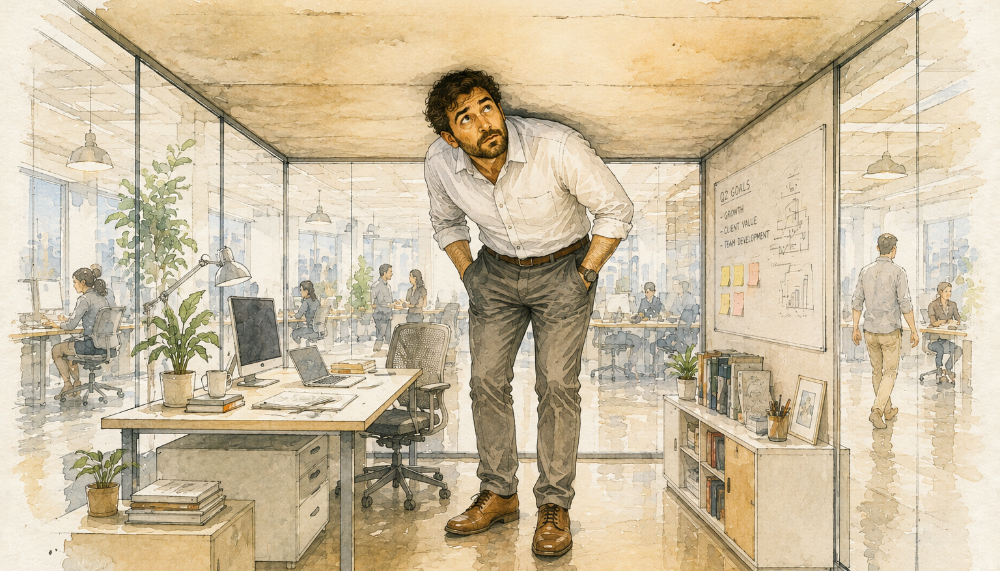
Gaurav had recently joined my team, and I was reviewing one of his first deliverables.
There was something in the work that I knew the client was going to resist.
I looked at him and asked, “Have I told you the story of the lake and the tube?”
He hadn't.
So I started telling him about something that had happened to me years earlier, when I was in Bangalore for my SSB assessment.
The lake and the tube
The SSB assessment goes on for four days. Some activities are done with all the candidates together. Others happen in smaller groups. And then there is the interview, which is one-on-one.
The interviews weren't scheduled in a particularly rigid way. Candidates would be called whenever it was their turn. When someone returned from an interview, the rest of us would gather around him and ask what he had been asked, what he had answered, and how he thought it had gone.
One of the candidates came back and told us about a question he had been asked.
The interviewer said, in effect: Suppose your assessments finish in three days and you have one day left. You could make use of the day by going for a picnic. We'll give you a bus, pack your lunch, and there is a lake nearby. How would you plan for it?
The candidate said, “I will take a tube with me.”
Everyone immediately asked, “Why a tube?”
His reasoning was simple. Why else would the interviewer choose a lake?
Clearly, someone was going to drown.
And if someone drowned, someone would have to save him. He couldn't swim, so jumping into the lake wasn't going to help anyone. The only sensible thing he could do was take a tube so that he could help the person without having to swim.
He hadn't been asked how he would rescue anyone. He had anticipated the problem before it happened.
We found the whole thing hilarious.
I didn't think much more about it at the time. The story stayed with me, but I didn't consciously connect it to anything I was doing professionally.
That connection came much later.
Don't wait for the resistance, plan for it
One thing I have told designers working with me for years is that they need to anticipate resistance.
When you make a design decision, don't just think about whether you believe it is the right decision. Think about what is going to happen when you put it in front of someone else.
What are they going to question?
What are they going to disagree with?
What are they going to say, “Why did you do that?” about?
Experience helps here. After you've been doing this for long enough, you start recognising the decisions that are likely to attract attention. Sometimes it is something significant. Sometimes it is a colour. Sometimes it is a typeface. Sometimes it is a layout decision that seems completely obvious to you but won't be obvious to the person looking at it for the first time.
The answer isn't to avoid making decisions that might be challenged.
The answer is to have the material to support the decisions you have made.
That material might be research. It might be an established design principle. It might be an example from another product. It might be a business constraint. It might simply be a well-thought-out rationale.
The point is that you shouldn't have to start thinking about why you made the decision only after somebody has challenged it.
The logo I knew they would hate
I learnt this particularly well while working at HCL on a product for a team supporting the retail vertical.
They were creating an app and had some very specific ideas about the logo. They wanted a human figure. They also wanted a particular treatment for the typography.
I knew immediately that there was no chance in hell I was going to create something like that.
But I didn't argue with them.
I listened to what they wanted, went away, and created something completely different.
My design had an eye in it. I don't remember exactly what prompted that choice, but it felt relevant to the product. I also used a more conventional treatment for the name rather than the style they had requested.
I also knew exactly what was going to happen when I showed it to them.
“What the fuck is this? We didn't ask you to create this.”
So I prepared for that conversation.
I didn't start the presentation by showing them the logo. I started by talking about what makes a good logo. It needs to be memorable. It needs to be relevant. It needs to be simple. There were five qualities I used to establish the criteria.
Then I addressed the requirement for a human figure.
I showed them how common that visual treatment was by putting up a screenshot of a Google search for human figures in logos. My argument was that if they used a visual that had already been used to death, there was a good chance their logo would disappear into a sea of similar logos.
If they wanted people to remember the brand, being different mattered.
Then I addressed the typography and explained why the treatment they had requested wasn't a good choice for a logo.
Only after I had established all of that did I show them what I had actually designed.
The logo was approved in that same meeting.
I'm not claiming that I had somehow become so good at persuasion that I could make anyone accept anything. The logo wasn't a particularly critical element of the business, and there was probably less at stake than there would have been with a major retail brand.
But I would have approached another client in exactly the same way.
I knew I was departing from what they had asked for. I knew they were likely to challenge me. So I made sure I had thought through the reasons for doing it before I walked into the room.
If you know your decision is going to create resistance, don't wait for the resistance to arrive before you start thinking about how to defend it.
The Client Is an Idiot, and I'm Oh, So Clever
There is another part of this that I find interesting when I look back at my career.
Earlier in my career, I would sometimes present work without having done this thinking.
And when the work was rejected, I would blame the client.
“They're idiots. They don't understand what is good.”
Then, as I became better at anticipating resistance and started getting the work accepted more regularly, I had the opposite reaction.
“I'm so clever.”
Failure was the client's fault. Success was mine.
That is a convenient way to interpret your career.
What experience eventually taught me was that there was something else going on. I had changed the way I approached the work. I had started taking responsibility not just for the design decision, but for what would happen when that decision met another person's expectations.
That is what I mean by professional ownership.
If You Can't Defend It, Why Did You Do It?
Owning your decisions means applying your experience to anticipate why someone can have a problem with them, and having the reason to support your decision.
If you know a stakeholder is going to question the colour, have a reason for the colour.
If you know the typeface is going to be questioned, know why you chose it.
If you have deliberately departed from something the client asked for, understand why you did it and be prepared to explain the trade-off.
This isn't about preparing a defence for every pixel. That would be ridiculous. It is about developing enough judgement to know which decisions need support.
The more experienced you become, the better you should get at recognising those moments.
And there is an important distinction here. This is not manipulation.
Clients have their guards up for a reason. They don't trust you by default. They have to learn that you are actually working as a partner and that your decisions are being made in the interest of the project rather than because you happen to prefer something.
"Why should I trust you?"
When they repeatedly see you make decisions thoughtfully, explain them honestly, and challenge their requests when you believe there is a better option, something changes. They become more comfortable with your judgement.
On projects that last long enough, clients often become friends.
But that relationship starts much earlier, with small demonstrations that you are thinking about the project rather than simply producing what was asked for.
You win some, you lose some
Of course, anticipating resistance doesn't mean you will always be right.
Sometimes your decision will be wrong.
Sometimes the consequence of a decision will be too minor to matter. Sometimes it will be significant but impossible to measure. Sometimes you will have perfectly good reasoning and the stakeholder simply won't listen to you.
When that happens, you record it, learn what you can, and move on.
The value of foresight isn't that it guarantees success. It gives you a better chance of making a thoughtful decision and a better chance of having a useful conversation when that decision is challenged.
That is why I still tell the lake-and-tube story to designers who work with me.
The tube wasn't really the clever part.
The clever part was recognising that something could go wrong before it happened and preparing for it.
Good professionals don't just make decisions. They think far enough ahead to know which decisions are going to need defending.
When I review a designer's work today and see something I know a client is likely to resist, I don't want the designer to wait for the client to object.
I want them to have already thought about it.
Ah, here is Rahul, our new team member.
“Rahul, did I tell you the story of the lake and the tube?”