One of the most frustrating experiences in design leadership is watching the same team produce remarkably different outcomes across projects.
The designers haven't changed.
Their experience hasn't changed.
Their skills haven't suddenly improved or deteriorated.
Yet one project becomes something everyone is proud of, while another leaves everyone wondering what went wrong.
For years, I searched for explanations that felt reasonable.
Perhaps the successful project had a better client. Perhaps the team was more motivated. Maybe the budget was larger or the timeline more realistic. Sometimes I blamed difficult stakeholders. At other times I questioned whether we had hired the right designers in the first place.
Each explanation sounded convincing.
None of them explained why I continued seeing the same pattern across different organisations, industries and teams over the years.
The same people were producing completely different outcomes. That meant the real variable had to be somewhere else.
The Easy Answers
Whenever a project struggles, organisations instinctively search for someone to blame.
The designers weren't experienced enough.
The product manager wasn't clear.
The client kept changing their mind.
The developers pushed back.
The timeline was unrealistic.
Every one of these explanations may be true.
The problem is that none of them explains why another project, with many of the same people, succeeded.
If talent alone determined quality, great designers would consistently produce great work regardless of context.
Experience tells us they don't.
Likewise, difficult clients don't automatically produce poor outcomes, and collaborative clients don't automatically produce exceptional ones.
Something else is happening beneath the surface.
What Actually Changes?
After years of leading projects, mentoring designers and working with organisations of different sizes, I began paying less attention to the people and more attention to the environment in which they were making decisions.
That's when a pattern emerged.
The successful projects weren't simply staffed by better people.
They operated under better conditions.
The objectives were clearer.
Stakeholders understood their roles.
Decisions were documented.
Expectations had been established before disagreements appeared.
When conflicts arose, conversations returned to agreed principles rather than individual opinions.
The projects that struggled looked very different.
Objectives shifted.
Opinions replaced evidence.
Stakeholders bypassed earlier decisions.
Designers spent more time defending their work than solving problems.
The difference wasn't creativity.
It wasn't intelligence.
It wasn't motivation.
It was the quality of the decision-making environment.
The Client Was Never Really the Problem
People often tell me that good clients produce good work.
I don't think that's entirely true.
The best clients don't simply interfere less.
They create better conditions for making decisions.
They provide clarity.
They articulate business goals.
They respect agreed ways of working.
They trust expertise while remaining engaged.
Ironically, these clients are often following a process without consciously calling it one.
On the other hand, clients who constantly introduce new opinions, revisit settled decisions and micromanage every interaction aren't merely being difficult.
They're introducing new variables into an already complex system.
Without realising it, they're making consistent outcomes almost impossible.
The Moment My Definition of Process Changed
For a long time, I thought process meant workshops, documentation, templates and governance.
Those things matter.
But they are not the process.
They are simply visible expressions of something much deeper.
A process is not a sequence of activities.
It is a system that protects the quality of decisions.
The engagement deck isn't a presentation.
It establishes shared expectations before the project begins.
Documentation isn't bureaucracy.
It becomes the reference point when memories differ.
Design reviews aren't checkpoints.
They are opportunities to evaluate decisions against agreed principles rather than personal preferences.
Seen this way, every part of the process exists for a single purpose:
To reduce unnecessary variability in how decisions are made.
The Constant in an Equation Full of Variables
Every project contains variables you cannot control.
Different clients.
Different markets.
Different budgets.
Different timelines.
Different personalities.
Those variables are inevitable.
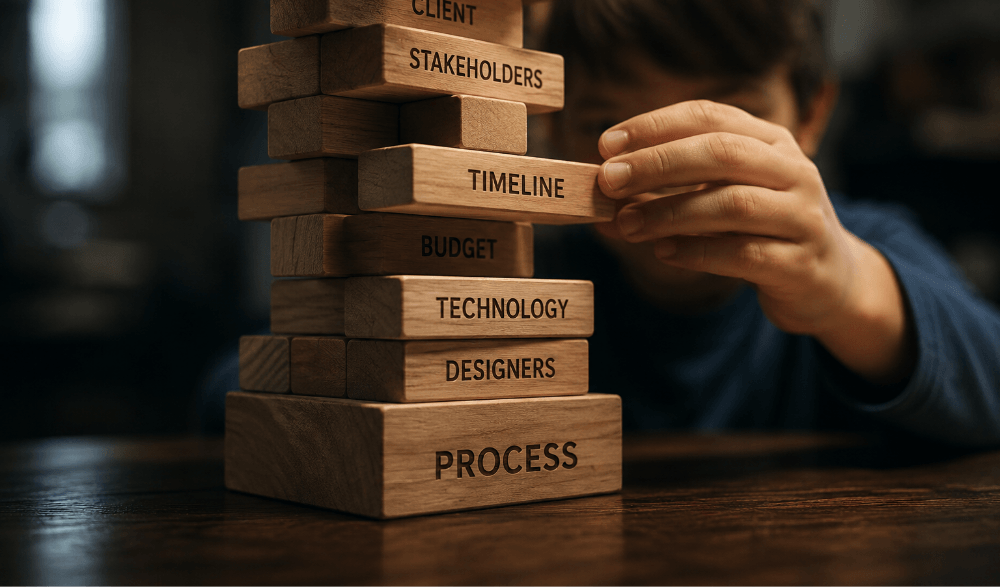
The mistake many organisations make is introducing even more variables by changing how they approach every project.
The kickoff is different.
The documentation is different.
Decision-making is different.
Roles are different.
Success criteria are different.
Eventually, every part of the equation is changing.
When the project succeeds, nobody knows why.
When it fails, nobody knows why either.
You cannot improve a system if every variable changes at the same time.
Every equation needs a constant.
In organisations, that constant is the process.
A good process doesn't eliminate variables. It introduces the one constant around which every other variable can be understood.
Once that constant exists, organisations begin learning.
They can isolate problems.
They can identify patterns.
They can improve deliberately instead of reacting emotionally.
Following a Process Isn't Enough
There's another misunderstanding that deserves attention.
Designers are often told to follow the process.
That's not the goal.
Following a process without understanding it creates compliance.
Internalising it creates judgment.
The most experienced designers I've worked with don't carry a checklist in their heads.
They understand why each part of the process exists.
That understanding gives them confidence.
Not confidence to win arguments.
Confidence to redirect conversations.
Instead of saying,
"I don't think that's a good idea,"
they ask,
"What problem are we trying to solve?"
"Does this align with the objectives we agreed upon?"
"What evidence supports this decision?"
They're not defending their designs.
They're defending the integrity of the decision-making process.
That's a very different level of professional maturity.
Eventually, every designer reaches another milestone.
They learn the rules.
They internalise the principles behind those rules.
Only then do they know which rules can be adapted—and why.
That's experience.
Not abandoning the process.
Understanding it deeply enough to evolve it responsibly.
Looking Beyond the Designers
The next time your team produces exceptional work on one project and disappointing work on another, resist the temptation to immediately evaluate the designers.
Instead, examine the environment in which those designers were operating.
How were decisions made?
How were disagreements resolved?
What remained constant?
What changed?
You'll probably discover that the biggest difference wasn't the people.
It was the system surrounding them.
Because consistency has never been about removing every variable from a project.
That's impossible.
It's about introducing one constant that allows every other variable to be understood.
For me, after more than two decades of leading design teams, that constant has never been a template, a workshop or a document.
It has always been the process.