When a brand itself tells you to stop caring
You know Borosil? If you are my age, you know it as the premium borosilicate glassware company. The name meant something specific - glass, material expertise and a certain expectation of quality.
Recently I was looking for a toaster and came across one made by Borosil. I didn't think, "Borosil makes good products, so I should trust this toaster." My reaction was almost the opposite: "What are they doing making a toaster?"
I didn't have any reason to believe that Borosil was particularly good at making toasters. The expertise that had created my trust in the brand did not transfer to the new category. I could still have bought the toaster. But if I did, I would have been because it was good value for money, not because it was a Borosil product.
A brand earns trust by being known for something. The moment the connection between the brand and that something becomes unclear, the name itself starts losing relevance.
This is what makes brand expansion interesting. The question isn't whether a company is allowed to enter another category. Of course it is. The question is whether customers can understand why the company's existing credibility should extend into that category.
Trust has boundaries
There is nothing inherently wrong with a company expanding beyond its original product, some of the strongest brands have done exactly that. The important distinction is whether there is an understandable connection between what the company was trusted for and what it is doing next.
Imagine Borosil expanding from borosilicate glassware into other glass products. Glass plates. Bowls. Jars. Storage products. Perhaps other categories where its material knowledge and manufacturing experience remain relevant.
I can understand the connection, the product may be new, but the reason to trust the company is still recognisable.
I think of this as adjacency of trust. A brand can move into a new category when the underlying capability that created its reputation still gives customers a reason to believe the company will be good at the new thing.
While glassware is an understandable extension, a toaster is a much harder leap.
That distinction matters because a brand is not simply a name. It is a mental shortcut. It reduces the amount of information a customer needs before making a decision.
When that shortcut works, the brand has economic value.
Sometimes the brand creates doubt instead of trust
Toyota and quality plus reliability are synonyms. This isn't just a perception I have formed from looking at specifications or reading automotive reviews. Toyota's reputation for reliability has almost become folklore.
People talk about Toyota's durability as if it were a given. It appears in jokes, stand-up comedy and memes. There is even a recurring joke about Toyota recalling cars from decades ago because they are still on the road and the company is feels the owners ought to have bought a new one. There is one by the host of an andventure show who said if you want to go in a jungle, take a Land Rover, if you want to come back out of the jungle, take a Land Cruiser.
These stories reflect the mental model people have built around Toyota. The brand has such a strong association with reliability that the reputation itself has become part of the product.
That association matters because buying a car is an enormous decision. You rely on the brand to stand for something. When you buy a Toyota, you are not just buying the specifications on a sheet. You are also buying into decades of accumulated belief that the company knows how to build cars that will keep working.
But when I learned that Toyota was selling cars sourced from Maruti Suzuki, it created a seed of doubt for me.
I own a Suzuki Baleno, and after around 80,000 kilometres its engine failed, the car extremely light and not comfortable on bumps.
Baleno becming a Glanza was hard to swalow. My question was no longer simply whether the particular car was good. It became: If Toyota is willing to make this compromise, what else might it be compromising on?
The danger of weakening a brand promise is not always that customers immediately stop trusting you. Sometimes they simply start asking questions they never used to ask.
Trust is often invisible when it is working. You don't consciously think about all the reasons you trust a brand. You simply use the brand as a shortcut.
But once something breaks that shortcut, you start looking behind the name.
The Attack of the Clones
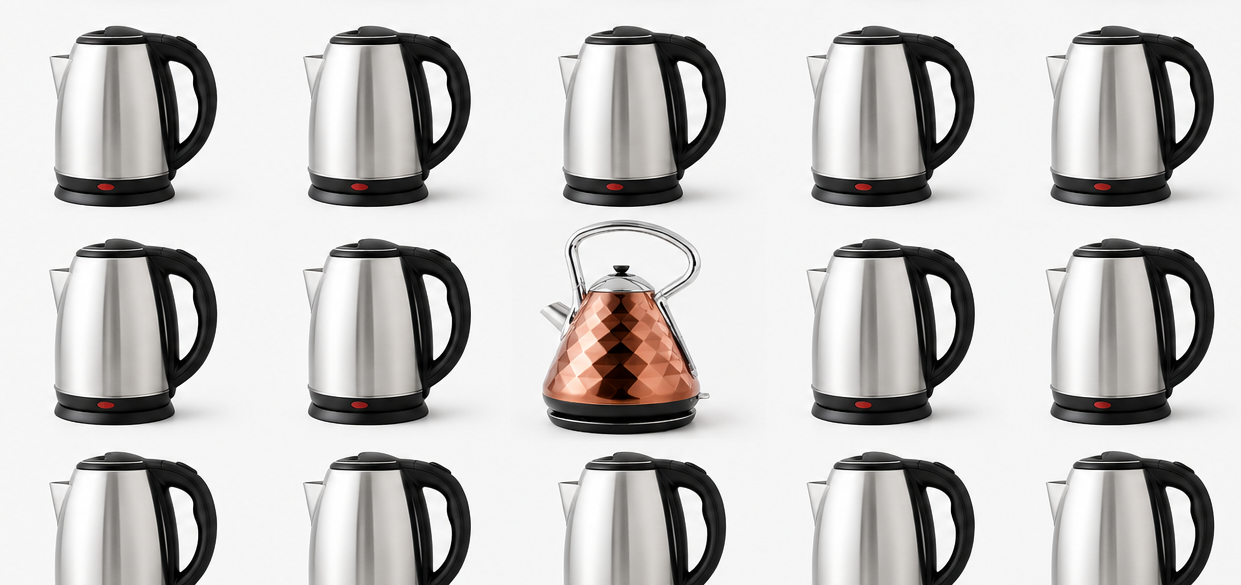
Think about buying an electric kettle on Amazon. You might see Pigeon, Peacock, an Amazon brand, several smaller brands and a familiar electrical brand such as Bajaj.
Look at the products and, in many cases, they appear remarkably similar.
Perhaps they come from the same manufacturing ecosystem. Perhaps the internal components differ. Perhaps one is genuinely better engineered. As customers, we often don't know.
If five kettles look identical, the decision becomes much harder to base on expertise, craftsmanship or engineering. Instead, the comparison starts moving toward price, reviews, features and perceived value.
The brand has entered a generic market and accepted the rules of that market.
That is a much bigger problem than simply expanding into an unrelated category.
Because every company selling generic kettles could have done something else.
They could create a differentiation, but the chose lower cost of procurement, and for what? A better quartely number?
They could have created a kettle that looked different. It could have introduced a feature that customers genuinely valued. It could have made the product recognisably its own.
Instead, if the result is indistinguishable from everything else on the virtual shelf, the brand is left trying to explain why its identical-looking product deserves a premium.
And that is difficult.
Customers cannot easily see workmanship. They cannot see engineering quality. They cannot see durability. They cannot see the decisions made inside the product.
They see five similar kettles.
So they ask the most rational question available to them:
"They all look the same. Why should I pay more?"
Efficiency has a cost that doesn't appear on the balance sheet immediately
None of this means that companies are irrational when they make these choices.
Businesses face enormous pressure to reduce costs, increase margins, move faster and find new sources of revenue. Outsourcing, standardised components, common suppliers, private-label manufacturing and economies of scale can all be perfectly sensible business decisions.
There is also market pressure. Sometimes customers stop caring about the thing that originally made a company special. Sometimes the original category becomes too small or too competitive. Sometimes a company has to change simply to survive.
That is the part of the discussion I find important.
It is easy to look at a company expanding into unrelated categories and say, "They are destroying their brand."
But perhaps the company is simply adapting to reality.
Perhaps the market no longer rewards the capability that built the brand.
Perhaps remaining distinctive is no longer economically viable.
Perhaps the choice is not between preserving the brand and making more money. Perhaps the choice is between changing and slowly disappearing.
That makes the decision much harder.
The problem is that efficiency and distinctiveness often move in opposite directions. Efficiency encourages standardisation. Standardisation makes products easier to manufacture and compare. And when products become easier to compare, differentiation becomes harder.
Efficiency happens inside the business. Distinctiveness has to be visible outside it.
The problem with asynchronous metrics
This is where I think many businesses face a structural problem rather than simply a leadership problem.
Profit is measured in quarters.
Revenue is measured in quarters.
Margins are measured in quarters.
Market share is measured in quarters and years.
But brand value is accumulated over decades.
A company can make a decision today that improves its financial performance immediately while weakening a customer association that took twenty years to build.
The first effect appears in the next financial report.
The second may not be visible for years.
This creates a dangerous asymmetry. Organisations have sophisticated systems for measuring short-term performance, but much weaker ways of understanding the gradual erosion of trust, distinctiveness and relevance.
So the problem may not be that leaders don't care about the long term.
It may be that the organisation has much better instruments for measuring the short term.
I don't think the answer is that brands should never diversify.
That would be unrealistic.
The better question is: What should remain recognisably true when a brand expands?
If Borosil moves into another category of glass products, there is a reason for the customer to extend existing trust.
If a company known for engineering excellence develops a new kind of product using that same engineering capability, the connection is understandable.
But when the only connection between the old product and the new one is the logo, the brand is being asked to do something it may not be capable of doing.
The name is being expected to create trust without the underlying evidence.
And if the product itself is generic, the situation becomes even more difficult.
At that point, the brand can become little more than packaging.
What I would do if I were building a brand today
If I were starting a brand today, I would be very reluctant to begin with the obvious question: What product can we sell?
I would start with the problem.
What is broken? What do people struggle with? What can be solved meaningfully? Where is there an opportunity to create something that is genuinely different from what already exists?
That might mean creating an entirely new product category. Or it might mean taking an existing product and solving an important problem in a way that customers can immediately recognise.
This is harder today than it used to be.
Copying has become incredibly easy. Once something works, its visible characteristics can often be reproduced quickly. A competitor doesn't necessarily need to understand everything that made the original product successful. It can copy what customers can see.
Which makes genuine differentiation even more important.
The goal shouldn't simply be to create something that looks different. It should be to build a capability, insight or solution that gives customers a meaningful reason to choose you.
Because a brand is created when that name consistently comes to mean something.
So what is your brand actually selling?
The paradox of modern business is that many of the things that make a company more efficient also make its products more similar to everyone else's.
There is nothing inherently wrong with efficiency. Companies need to survive. Markets change. Customers change. Businesses have to adapt.
But adaptation should not mean forgetting what customers were trusting you for.
A brand is an accumulated expectation. It is a reason to believe that the product carrying that name will be different in some meaningful way.
When that reason disappears, the brand doesn't necessarily disappear immediately.
Something more subtle happens first.
Customers stop using the brand as a shortcut.
They start comparing products instead.
And once customers are comparing products that look the same, the conversation inevitably moves toward price.
That may be an excellent outcome for efficiency.
It is a dangerous outcome for a brand.
The real question for any company expanding into a new category is therefore not simply, "Can we sell this?"
It is:
"What will this product make our brand mean?"
Because if everyone becomes more efficient by becoming more similar, eventually the thing that separates one brand from another is the very thing they have been steadily giving away: distinctiveness.