A few months ago, I found myself thinking about how different my design process looks today compared to ten years ago.
When I started working on a new project a decade ago, my first step was almost always the same. I would browse the internet for inspiration. I would look at dozens of websites, interfaces, and design galleries—not because I wanted to copy them, but because I needed a starting point. Looking at enough examples helped me understand the problem and gradually form ideas of my own.
Today, I still begin by understanding the problem. That hasn't changed.
What has changed is what I do next.
Instead of spending an hour searching for inspiration, I have a conversation with AI. I explain the problem, explore different approaches, challenge my own assumptions, and ask AI to help me think through multiple possibilities. The internet was once my source of inspiration. Today, AI has become my thinking partner.
That shift made me ask a different question—not how AI has changed design, but how it should change the way we evaluate designers.
The Job Has Changed. Has Our Hiring Process?
Technology has always evolved faster than the systems around it.
When the internet became mainstream in India during the late 1990s and early 2000s, businesses suddenly needed websites, digital products, and online experiences. However, educational institutions continued producing graduates trained primarily in traditional disciplines like painting, sculpture, and communication art. Most designers working on digital products learned those skills on the job.
The market evolved first. Education followed later.
We are witnessing the same pattern with AI today.
Designers have already changed how they work. The question is whether recruiters have changed how they evaluate designers.
My Design Process Looks Nothing Like It Did Ten Years Ago
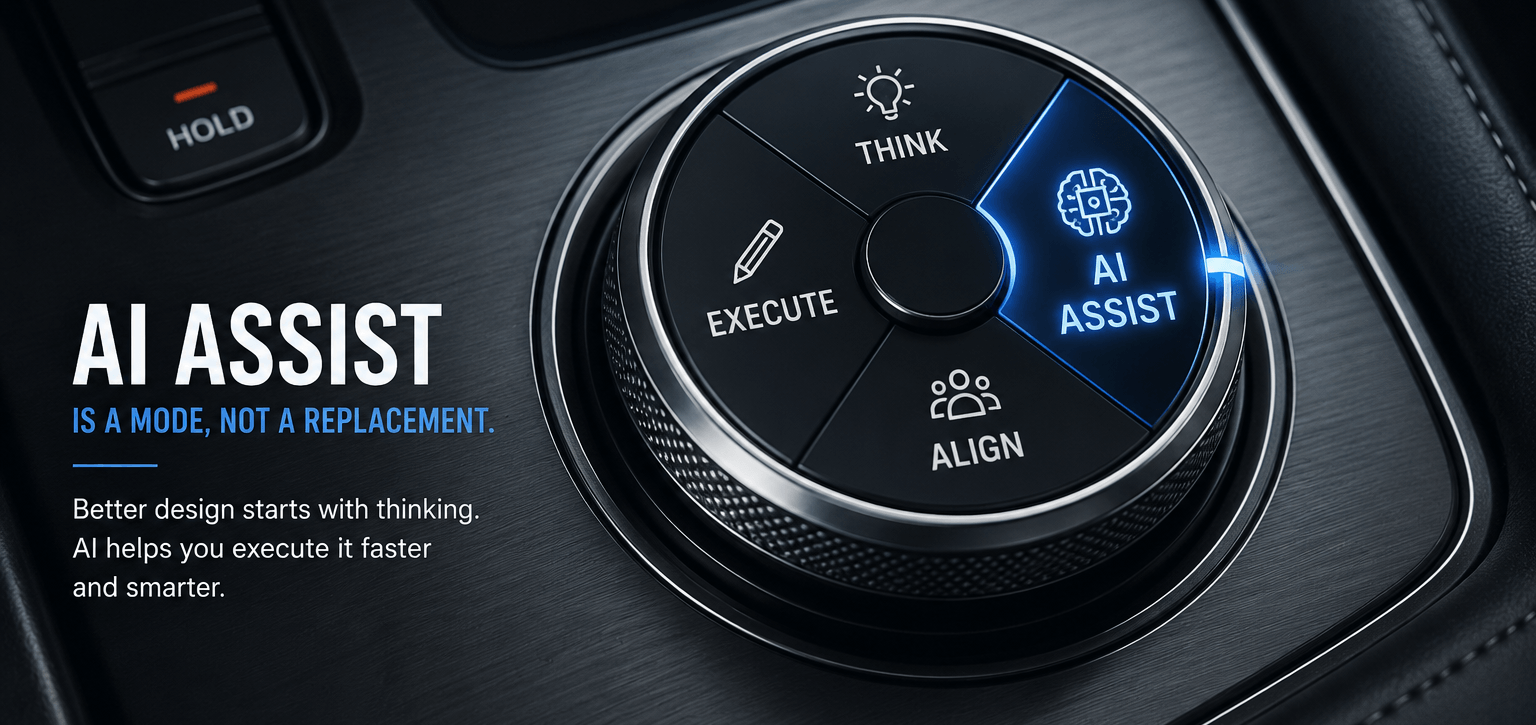
AI hasn't replaced my work. It has changed how I work.
Instead of manually creating every variation, I can now explore multiple layouts, color systems, navigation structures, and interaction patterns within minutes. Instead of spending time inventing realistic sample names, addresses, email IDs, phone numbers, and company information for mockups, I ask AI to generate realistic datasets that make my prototypes feel authentic.
Even prototyping has changed.
Years ago, whenever I wanted stakeholders to truly understand an interaction, I often built small HTML prototypes because static mockups couldn't communicate behaviour effectively. Today, AI allows me to build interactive HTML prototypes much faster, making it easier to communicate exactly how a product should work instead of asking others to imagine it.
The biggest difference isn't that AI designs for me.
The biggest difference is that AI removes friction from the design process. I spend less time producing assets and more time solving problems.
AI Has Raised the Floor, But It Hasn't Changed the Ceiling
This is perhaps the single most important idea recruiters need to understand.
AI has raised the floor.
Today, almost anyone can produce work that looks reasonably polished. Better typography, cleaner layouts, better spacing, realistic content, and attractive color palettes are now available to everyone.
The minimum quality has gone up.
But the ceiling hasn't changed.
The best designers still differentiate themselves through things AI cannot contribute on its own:
- Understanding the business problem.
- Understanding users.
- Identifying constraints.
- Making thoughtful trade-offs.
- Prioritizing information.
- Knowing when to reject AI's suggestions.
- Communicating decisions with confidence.
AI can generate solutions.
It still depends on humans to define the right problem.
Prompt Writing Isn't the Skill That Matters Most
Many people believe prompt writing is becoming the defining skill of designers.
I disagree.
The quality of AI's output depends much more on the quality of the problem you present than the cleverness of the prompt itself.
There is an old Hindi saying:
Jitni cheeni daaloge, utna meetha hoga.
The more context you provide, the more clearly you define users, business goals, constraints, and expectations, the better AI performs.
The real competitive advantage is not prompt engineering.
It is problem definition.
What Should Recruiters Evaluate Instead?
This is where I believe hiring practices need to evolve.
If I were interviewing a designer today, I wouldn't restrict the use of AI.
In fact, I would encourage it.
That is exactly the environment they will work in after joining my organization.
An interview shouldn't test how well someone performs in an artificial environment where modern tools are unavailable.
Use whatever tools you think are appropriate. Solve the problem, and then walk me through your thinking.
That discussion is significantly more valuable than judging whether every pixel was manually created.
Here are the questions I would ask:
- How did you understand the problem?
- What assumptions did you make?
- How did AI help you?
- What suggestions from AI did you reject?
- Why did you choose this solution over the alternatives?
- If you had another day, what would you improve?
Those answers reveal the designer.
The final screens reveal only the outcome.
A Necessary Caveat
It would be dishonest to claim that AI hasn't replaced designers in certain scenarios.
There are many situations where "good enough" design is all that's needed.
A small restaurant creating a menu, a local business designing a flyer, or someone producing a simple social media graphic can often achieve satisfactory results using AI alone.
For those situations, AI has genuinely reduced the need for professional design services.
This article isn't about those scenarios.
This article is about hiring designers who solve business problems, build products, improve user experiences, and make decisions that AI cannot make independently.
Recruiters Have an Opportunity
Recruiters cannot redesign university curricula.
They cannot slow down technological change.
But they can change how they evaluate talent.
The designers who will create the greatest value over the next decade will not necessarily be the ones who execute every detail manually.
They will be the ones who understand problems deeply, collaborate effectively with AI, question its output, and make better decisions than AI can make on its own.
AI has raised the floor.
The ceiling remains exactly where it has always been.
The designers who reach that ceiling will continue to stand apart because of their judgment, empathy, curiosity, and ability to solve meaningful problems.
Perhaps it's time our hiring processes started rewarding those qualities.